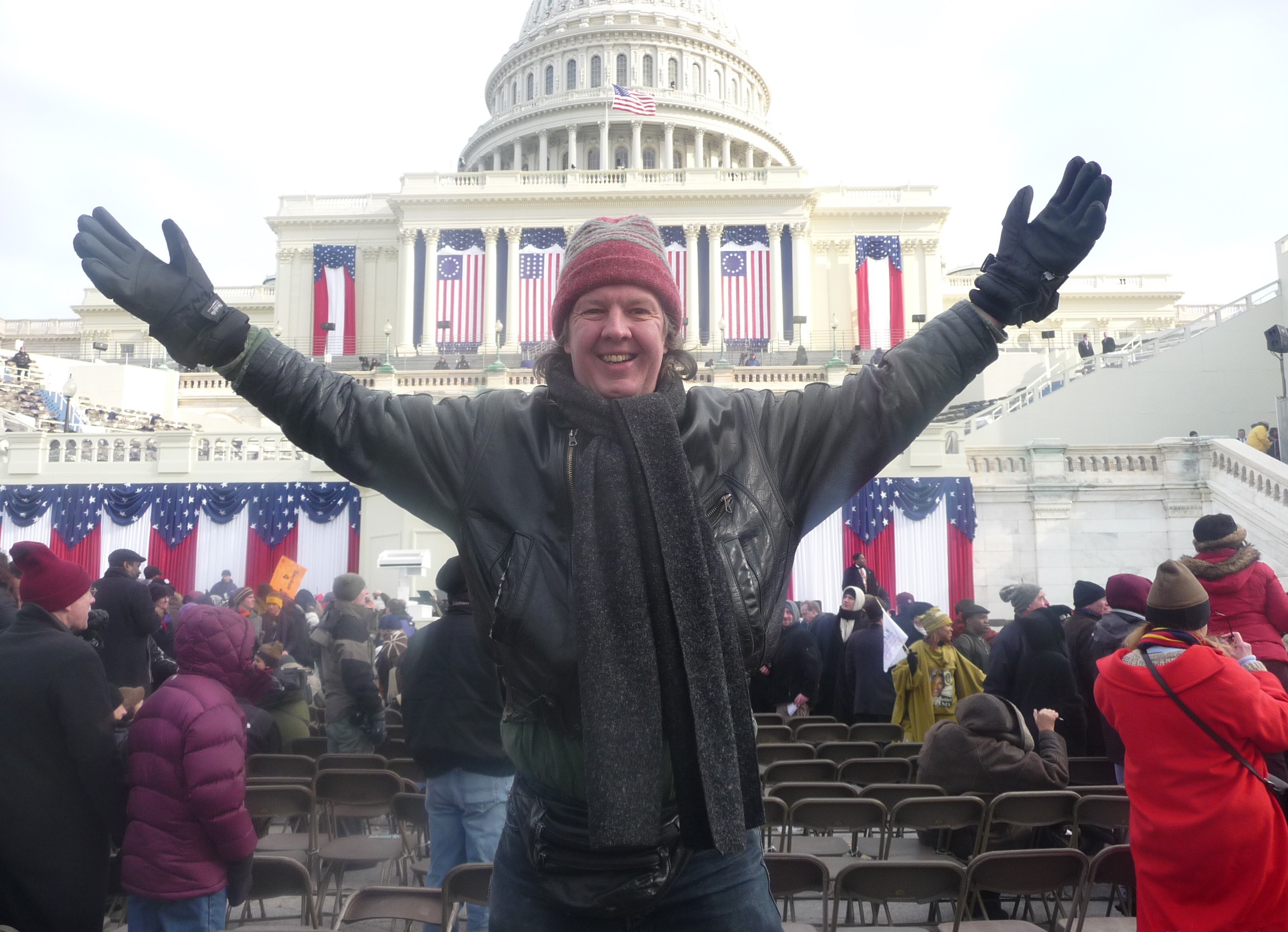
We were out there at Sands Point, Long Island, shooting a Steve Winwood video in one of those Great Gatsby mansions, hanging at this round banquet table with just Steve and the prop guy and a couple others, and he was talking in his gentle British accent which seemed so perfect for this estate we were on since it was originally built as a replica of an English castle — and somebody at the table was complaining about the new Bob Dylan album, and Steve, who’s a very reserved guy, like an elder royal himself, and after this slagging of Bob goes on for a while, finally Sir Winwood speaks up in his soft tone and says, “For me, he can do no wrong,” and that pretty much put an end to the Slag Bob conversation. “In fact, when he was in England on that first electric tour in ’66 we met up and went exploring places like this out in the English countryside. Very curious was Bob.”
As usual on these shoots there’s a lot of hurry-up-and-wait downtime, and besides listening to the sound of the Traffic, I started exploring this huge castle, and these things are so stupidly big you can get lost in them — hallways that go on forever, and rooms beget rooms beget rooms. This particular mansion has been a set for loads of movies and TV shows and such and so all different sections of it were decorated like different sets — there were futuristic rooms, psychedelic rooms, 1800s rooms, royal rooms, billiard rooms, dining rooms, and half of them have giant fireplaces imported from Europe that you could park a truck in — so I’m just prankstering about hell-bent on exploring every inch of it, and after I get a fair handle on its architecture, I go check back in with the shoot, and they’re mucking around with these Ferraris out front and I start talkin’ to the prop guy again who’s out there and actually lives on the Island, and he’s saying, “Yeah-man, these Japanese guys are precision-guided maestros,” nodding to the collective of cinematographers. They’re all speaking Japanese and nobody else knows what the hell’s going on, but it’s a glorious day and no one cares. And I look at the mansion from the outside, which I hadn’t really done seen since we arrived when it was still dark, and notice for the first time there’s a giant turret at one end that I somehow missed. And I’m like, “Who-boy, this is some kinda house, eh?!”
And there’s a long pause as he sizes me up anew. “Yeah, sure is, … Canadian. … You never been here before?” he asks as I though I should have been, and maybe he’s right.
And I’m, “What’s with that turret? Can you get up in that thing?”
And he’s, “Yeah, of course.” Then another long pause. … “You wanna smoke a joint?”
And I’m, “Hmm, lemme think about it for a minu… — yeah.”
And he flashes the eyebrow high-beams, a slight nod towards the front door, and, “Let’s do some location scouting.”
And off we go. He’s got the walkie-talkie-thingie and we can hear people squawkin’ away, and he’s, “We’re done with the interiors, I’m basically off for the day.” And since I’m the producer’s assistant who seems to have forgotten I’m here, off we go, up the grand staircase with carved heads on the corners of the banister, and down the dark hall past supplies left behind from various shoots and stray furniture that made it look like you were at some mansion in the middle of moving day. And at the very end of the hall he goes, “This was the master bedroom,” as we walk into this massive room with stained glass windows on three sides and another ornate fireplace the size of a garage and enough floor space to drive around in circles.
And Rick, that’s his name, walks straight into the corner of this paneled wall like he’s going to disappear into it but pulls a little hidden handle right outta the wall and this big wooden panel opens up and there’s a dark spiral staircase! In we prank, and up we go, creakin’ ancient wood that was clearly not part of any restoration plan, until we open a door and Boom! There’s the Atlantic Ocean! Actually, Rick corrects me, “It’s Long Island Sound,” but it’s still the ocean saltwater, and you still can’t see land on the other side, so I’m stickin’ with “ocean.”
And we’re on the top of this big round turret with battlement teeth for the archers to hide behind, and although it was perfectly calm down on the grounds, there was a healthy summer’s breeze up there, so we spark the fattie behind a rampart, and he starts telling me how he grew up on the Island. “Yeah-man, I’ve seen these things change so much over the years. Half of these old mansions are falling down, and the other half … found me stumblin’ around drunk on Burgundy wine,” he starts singing from “Wharf Rat!”
“You’re a Deadhead?!” I blurt in surprise.
And he smiles mid-puff and somehow knew that I was already.
And after he holds in the smoke a couple of beats and blows it out, “Yeah-man, since Englishtown ’77. You?”
“Seattle 1980. … But Radio City were my 2nd through 7th shows.”
“There ya go. … That was the best New York run ever.”
“I snuck into my second show there,” and I tell him that helluva story, and weir riffin’ and the walkie-talkie’s squawkin’ at the seagulls, and the blue sky is lookin’ bluer, and the day just keeps getting better.
“Yeah, we used to sneak into a these old mansions when we were kids.”
“No WAY! We did that in Winnipeg! … But of course the mansion was the size of the gatehouse at this place, but still!”
And he’s, “Yeah-man, they’d have them fenced off, but … we were kids, right?” and he winks and I know and we laugh. And out of the blue sky he says, “If this thing wraps early, and it looks like it might, there’s a benefit dinner just down the road that my buddy’s doin’ sound for. We should stop in. You wanna see a real castle?” and he does that prankster nod, like, “You ain’t seen nuthin’ yet, kid.”
So, we go back to the front grounds and the mid-afternoon Ferrari exteriors were the last scene of the day, and my producer pal was beaming with how everything had gone especially since Winwood was being so agreeable, happily sittin’ or standin’ or walkin’ or doin’ whatever they asked him to. He’d said at the table, “I have no idea what they’re doing. I just make the music. They can take whatever pictures they want.” And finally you hear those magic words on every shoot, “Okay, that’s a wrap for today, folks. Tomorrow morning 5AM, Wall Street” — and it’s like “Action” was just called for the hundred or so fairly stationary crew people who all snap to and start breaking down gear.
I go over to the producer. “How YOU doin’?!” and she smiles a huge, “Oh yeah!”
“Okay, I’m gonna help the prop guy pack up,”
“Good,” she says, already lost in her next-step production thoughts.
“And I think I’m gonna catch a ride back to the city with him. You cool for the rest of the day?”
A long pause, “Yeah. I’ll see you at 5 tomorrow at Wall & Hanover. Get some sleep,” she says.
Woo-hoo! I’m off!
And I spot Rick already driving his van around the car-wide walkway to the parking-lot-sized terrace overlooking the Sound, and we load up candelabras and ornate music stands and a cello and giant framed paintings and all this weird stuff that appeared in the shoot somewhere, and he looks at the time. “The benefit starts at six, we should be good.”
On the drive there he starts telling the whole backstory of the Gold Coast scene to this wayward Canuck. “Yeah-man, these things were all built around the turn of the century before there was income tax — the megarich industrialists and bankers and shit —Vanderbilts, Morgans, Guggenheims, Woolworths … all those guys who made more money than they could spend — so they built these castles to show off and entertain their friends — Great Gatsby land, ya know? — except they actually shot that in Rhode Island, the bastards. Course, that was before my time anyway.”
And suddenly we hit the town of “Manhasset”!! — “NO WAY! That’s my name!!”
“Yer kiddin’, really? Funny. Maybe your ancestors were here. Maybe one of these mansions is yours. Never know.” And I’m half-way believing him and spend the rest of the trip craning my neck for “Hassett House.”
And after a while weir drivin’ along a road past a tall vine-covered fence and he points with his thumb, “This is it.”
“What, Hassett House?”
“No,” he laughs, “Where the benefit is.” But we still keep driving what seems like about an hour before we get to the gate, and of course there’s rent-a-cops and guys with clipboards and headsets, and Rick pulls right up to the giant gatehouse, “We’re Magnum Sound.” And the guy starts flippin’ through pages, and he says, “Okay,” but then, “Wait — there’s only one vehicle,” meaning only one truck cleared to get in, and it’s already there. And Rick goes, “Yeah, that’s Marco. He just called and the patch cords are fried,” and he points behind in the van like we’ve got the new ones. And the doorman nods, then motions to the gatekeeper, who swings open the black gate and suddenly weir driving past the guards into this private park of a front yard with a canopy of trees like The Mall in Central Park except the road weaves and winds until we come out at this castle about three times the size of the last one!
There’s a bunch of production trucks and another guy with a clipboard and a headset. Rick: “We’re sound.”
“You have to load in?”
“No, already did. We’re tech.”
“Okay, follow this around to the right and there’s parking in back.”
And Rick doesn’t say a word, just nods like he’s done this a million times, and I bet he has.
Then Boom we’re walking into this giant shiny modern kitchen in this old Versailles of a palace, with men and women completely dressed in white cooking up a storm and it’s loud and everyone’s moving fast and Rick and I just swim through the rapids and whoosh out the far door into some other anteroom leading into a giant high-ceilinged banquet room with about 50 chairs along each side of a single long table with all these men and women dressed completely in black putting the last touches on the table and placing covered trays of food around on side tables, and Rick & I just saunter through like we live there, then through another anti-room and into a giant ornate ballroom! with a two story high ceiling and huge oak beams and arched corners with a twinkling galaxy of stars painted on the ceiling between the beams. And there’s a black temporary stage and P.A. at one end, and sound mixer at the other. And Rick calls across the empty echoing room, “Marco!” And without missing a Beat, the figure behind the board starts speaking through the PA.
“Call in the clowns. I need all clowns stage left. . . . Jokers, you’re up next.”
“Hey, brother!” and they hug a quick one. “We just got off the Winwood shoot. This is Brian — Deadhead from Canada.”
“Canada!” Marco bellows. “Copps Coliseum! 1990. Best Hey Jude / Fantasy I ever heard,” he says without looking up from his board that he’s adjusting even though there’s no sound.
“The Boys doin’ Steve Winwood,” I add.
“Good one,” they both smile.
“So, what’s on tonight?” Rick asks.
“Sheryl Crow.”
“WHAT?!” I scream in my head but don’t say a thing to keep my cool, and look out across the ballroom floor to the stage and realize this is gonna be a private home performance by one of my favorite performers ever!
And the guys start talkin’ shop but I’m flashing back on all the times I’ve seen her — opening for Dylan at Roseland, the Irving Plaza show, Woodstock ’94 — and I’m also flashin’ on that 5AM call on Wall Street, and realize it’s gonna be one of those sleep-when-I’m-Dead routines.
And Marco looks at the clock on his board and goes, “Okay, they’re gonna be arriving in a couple minutes, have you seen this place yet?” and he takes us on a private tour of this private castle.
One crazy thing is … every room had another room in between. Like, you never just walked from one room into another, there was always some little sitting room or storage room or bathroom room or something in between every other room. And suddenly weir in this big library with floor-to-ceiling books behind leaded glass doors with big reading chairs you could picture Sherlock Holmes sitting in and of course another one of those giant marble fireplaces and it’s all dark except for bridge lamps leaning over each of the plushy chairs.
Then we wandered through this sunken indoor garden with a fountain in the middle and skylights for a ceiling, and everywhere there’s walls of windows that look like a church, and I’d lost count of how many fireplaces we’d walked past.
And we get out to the grand foyer that’s about the size of a cathedral with tall arching columns and these little chapel-like rooms that extend off the sides and the whole space has been turned into a giant bar for the night. Or multiple bars, such as it was, with more gorgeous women and men all in black, and apparently patrons had already started to arrive, and the room was alive, and everything echoes in these places so it sounds like a really loud party already. And there’s a guy in a red-&-white striped costume at an upright piano by the front door playing ragtime, and ol’ Marco goes, “You want a beer, Canadian?” The guy delivered everything totally deadpan. Never cracked a smile but was always sayin’ sumpthin twisted.
And we get to the bar and it’s nothing but bucketfuls of micro-breweries from Europe that I’ve never heard of. I get some Belgium white, and we make the rounds, but it’s obvious we’re not dressed for the occasion, so Marco’s like, “Let’s go check out the cliffs,” and Rick nods, and I’m like, “Cliffs?!”
And weir out the back door, and where the last mansion had a back yard, this place had a statue-filled fountain garden. And as weir walkin’ through it Marco starts explaining, “It’s some world hunger benefit. It’s ten grand a plate in there,” as we walk past reflecting pools with spouting putti and marble basins. And sure enough at the far end are these rockin’ hundred-foot cliffs with the sea crashing below, and Rick pulls out another stick o’ dynamite, and mid-conversation runs it through his mouth to dampen the paper so it’ll burn as slow as the fresh weed, and three old warriors get right with the muta to the crashing waves in the eternity of it.
And I’m flashing on Gatsby and his friends along these same cliffs at these same parties, and how even then I would not have been the guy in a suit, but the guy in the band or some other prankster in the play not wearing a uniform, as we riff on history with these Long Islanders from long before there was a hockey team or a Billy Joel, telling stories about Halloween parties on acid and seeing Springsteen in ’73 at My Father’s Place, the Island’s legendary music joint.
And after losing all sense of time with our feet dangling over the cliff, we all moan to get up, and mosey back to the palace, and enter through that same kitchen but this time it’s even crazier and louder and smells ever better, and we cut back to the grand foyer party which is now full, and the lights seem dimmer and it’s much crazier and rich people are letting loose, and I realize it’s sort of a rock n roll / film crowd — not Wall Street rich, this was crazy rich, and with the lights low and the crowd thick and the dress funky, suddenly weir sorta blending in, and I go back to the front door where there seems to be excitement, and people are comin’ in and having their picture taken, and they all look like movie stars, but I’m so not on that beat I don’t know if they are or not, except then somebody comes in and suddenly I see Tom Cruise come climbing over the top of the ragtime piano like a monkey, calling out to the people arriving while laughing his head off, and I’m thinkin, “Geez, this guy really is a climber!” as he comes down over the front end stepping on the keys and jumping into the arms of his friends.
And then there’s another fluster at the giant door and these two old ladies come in very slowly, and right behind them is Steven Spielberg! I think one of them was his mother, and flashbulbs are goin’ off, and there might have been applause or something, and I’m realizing this is gonna be some night! And also, who the heck else is here?!
So, I head back and score an unpronounceable German beer, and meanwhile Marco and Rick have disappeared, and I suddenly notice these people all know each other, and a solo prankster in workaday shorts ain’t gonna be making time with these cover girls, and I also realize it’s definitely true that rich gentlemen prefer blonds, and skinny ones, and young ones, and so before I get busted for staring I’m thinkin’ its time for a smoke on the sacred grounds and go out and join the welcoming crew on the white gravel driveway in front, and there’s a line-up of limos and cool vintage cars stretching back along that long and winding road we drove in on, and I fall in with the valets who didn’t have much to do that night, but here were the modern-day Neal Cassadys, paid to park cars. And like Neal, a lot of them were on the make for connections or chicks or whatever, but one of them was standing there just digging on the simple glory of the night, and he and I riffed back and forth about cars and luxury and celebrities, and just then a black Rolls door opens and Susan Sarandon and Tim Robbins get out! And I get a flash of that art imitating life last scene in “The Player” when the executive arrives home at his mansion driveway and kisses his blond wife.
And pretty soon all the beautiful people go into the beautiful banquet hall for their beautiful meal, and I scootch in while they’re packing up the bar and snag a fresh Dutch frosty to go with the fresh Dutch tobacco, and schlep around back to find Marco and Rick lounging at a table on the terrace. “Hey! We were wonderin’ where you were!” And after a few minutes of ketchup and jam, without any of us saying a thing, a couple girls from the kitchen must have seen us out the window and brought out three plates, and we had fresh salmon and veggies in the green garden with the sea air and the silver silverware. “So, … this is about 30 grand we’re eating right here?”
And I mine ‘ol Ricky for details on Englishtown, and he mines me for details on Wayne Gretzky, and Marco didn’t mind any of it.
And then Boom! I suddenly remember Sheryl Crow’s gonna be playing!! What?!?
And after a fine after-dinner Dutch cigar we head in and now everybody’s drunk and gettin’ drunker. And weir back in the ballroom but it’s full of people and the lights are low except for a subtle illumination of the stars above, and Sheryl and her band come out to a roomfulla friends and play it as such and have a grand ballroom time.
So of course I go right up front and it’s just a little three foot stage that I coulda just jumped up on and hugged her, which I certainly wanted to do, but instead just danced at her feet.
She opened with the perfect “It’s Hard To Make A Stand” for everyone who was there doing that with their presence. Into “Redemption Day” and I was getting the feeling this whole set was gonna be thematically linked, and boy did that turn out to be right, and I bet she does a lot of these benefit gigs that nobody ever hears about. “I’ve wept for those who suffer long, But how I weep for those who’ve gone,” and I gotta admit I totally lost it — for those I’ve lost and we’ve lost and the beauty of fate and life that put me in this place at this time. Then if that wasn’t enough she goes into the beautiful tear-inducing ballad “Angels” and this has become some kinda gospel show — “When you’re pulled from the wreckage, You’re in the arms of an angel, May you find some comfort here.” And it’s weird because you gotta sorta hold it together when you’re in a room full of people, but I wasn’t doing a very good job.
And then thank gawd she left the tear-jerkers behind and went into a rockin “Love Is A Good Thing,” with the lyrics about “buying a gun at Wal-Mart stores” that got her album banned at all their shit stores in the world. Then she went into the challenging “Strong Enough” from her first album — every song about empowerment in one way or another. And then into a thrashing “A Change Will Do You Good” and I looked over and there was Tim Robbins and Susan Sarandon dancing like teenagers, and Tim was like me with my girlfriends in that he’d dance away and film some partygoers or Sheryl with this little hand-held he had and then go dancing back to Susan, and everybody’s havin’ a grand time, just fans of the Dance. Then I couldn’t believe it — she did Dylan’s “Mississippi” — a song of his she recorded before he did. And again I’m half-way losin’ it standing five feet from Sheryl singing Bob in this private ballroom with no thought a few hours ago that anything like this was gonna happen. And there may have been a few other songs in there but she ended with my bar-none favorite live song she does, the Keith Richards-channeled “There Goes The Neighborhood” and just rips the roof of the place. “Hey! Let’s party! Let’s get down!” And I remember this song winning the Grammy for best female vocal performance and MAN you can hear why!
And when it’s over I’m just a ball of sweat and a beaming sun, almost frickin’ shaking, and on wobbly knees make it back to the soundboard and there’s Ricky smiling. “Enjoy yourself?”
And the wonderful thing is, it was over by about 10:00 or sumpthin and Rick’s, “We gotta go.” Old pro that he is, it’s a 5AM call. And Boom! Long story short, we pull off the drop off, and I next see him but a few hours later, reunited in this same evening’s darkness for the next scene on a silent empty Wall Street in downtown New York City.
The Adventure of the Boulder ’82 On The Road Conference —
Finding Kerouac, Kesey and The Grateful Dead
Alive & Rockin’ in the Rockies
.
One of the first and forever impressions I had was — being on the inside hanging with Allenand his loopy longtime lover Peter and Beat badboy Gregory Corsoand cigarette-chaining novelist John Clellon Holmes in their little homes, just watching these guys, these old friends who’d been brothers of the night and the light since they were the age I was as I was meeting them, and now here they were much older, full-grown adult MEN, who were still pranksterish, still plotting cool adventures, still finishing each other’s sentences, still knowing what the other meant by just a gesture or a silence, and making each other laugh, constantly, but all within the context of business, productivity, doing things, writing things, working things out. They weren’t sitting around talking about sports or half-baked pontifications about politics or trying to prove they were up on the latest band like so many people my age. No. They’d been playing this poetry productivity game forever and probably never even noodled in those foolish things but were talking about philosophy and spirituality and writing and writers and quoting themselves and quoting others and talking over each other and as excited in the moment as little kids.
Allen was definitely the professorial boss, the accepted (but not to say unchallenged) ringleader. He was always carrying around this cloth sorta Guatemalan over-the-shoulder bag full of papers and schedules and books and god knows what, and usually wore some stray suit jacket a couple sizes too big for him with some tie a couple sizes too small. He was gentle, but vibrant; soulful, but lascivious; clipboard following, but constantly poetically improvising. He was sort of the one and only father figure keeping an eye on everything, yet was always fun to be around. He had no problem correcting or admonishing someone, but did so with love and a tender demeanor.
He was like a referee in a pick-up game — making sure we played by the rules, but knowing the whole game wasn’t too serious.
Gregory seemed to always have on this black leather vest looking like a slightly older Dylanfrom “Street Legal,” like a hot happening sexy dude, with a full head of bushy black hair. He would definitely have been the (and probably only) lady’s-man of the group. He didn’t give a damn about the outcome of the game, he just wanted to score. He was definitely the Puck, the imp, the joker, and the one most likely to be called to the principal’s office. And thank god he was in with the principal or he woulda been expelled fer sure!
And a neat thing I loved — the long-form novel writer John Clellon Holmes had a slower cadence than the rest, and a softer voice, and when he’d solo on his Horn, the rest of the band laid low. There was an unspoken respect — perhaps still stemming from him being the first of any of these soon-to-be-famous young men to have a Beat book published — his gone novel “Go,” in 1952.
He wouldn’t speak too often — whereas Allen and Gregory were like Dizz and Bird, constantly playing off and over top of each other — but John would come in like the organ and lay down these thick slow chords that would then totally alter the next round of soloing. He was Zeppo, the thoughtful straight Marx Brother who didn’t really fit in with the others, yet was one of them, and there was nothing he could do about it.
What was extraordinary was that they were exactly like I dreamed and imagined they would be — and as they conveyed themselves from the ’50s. Close friends just hanging out, but always up to sumpthin.
And I thought back to seeing that poster that made me embark on this trip, and the karma / fate of that, and how it was the phrase “Partially funded by The Grateful Dead” that tipped the scales from “I should” to “I’m going” — but whatever the hell it was, I’d somehow made my way here and was now studying Hangoutology with my heroes. And unlike hanging with rock stars, writing was my art form of choice and practice. Instead of being in private circles of master musicians, I was now sitting among the masters whose music I played.
And another guy who blew me away early and often was Herbert Huncke. I’m not much one for these junkie guys, but Huncke was a trip. He was SO nice, so friendly — the most personable people-loving people-person you could ever meet. But it was the guy’s cadence, how he spoke — it’s no wonder Jack & Allen & Company totally dug this guy. Whereas I tried to talk to mumbly Burroughs a few times, but he was as freakin’ weird and misanthropic as he comes across. The adding machine magnate’s grandson in the grey flannel suit may have been a Queer and a Junkie, but other than that he sure didn’t seem to have much in common with the other Beats I knew and loved — not the same celebration of life, joy, optimism and gushing compassion in his heart.
Although Huncke may have shared some of Bill’s proclivities, he was personable and gentle and open in his own peculiar way. Just a few degrees shy of being locked in a federal pen, he was a total character — and that was this constant commonality to most of the people in ol’ J.K.’s life. Odd ducks. As a novelist, Jack magnetized to these people as fodder for his fiction. Whereas Allen was sort of a businessman, a promoter, a former market research man, and Gregory was a bit of an aggressive hustler and loose cannon, Huncke was absolutely “one of us,” not intimidating in stature or demeanor, just a guy you could sit with for hours who’d engagingly listen to whatever your story was, and then share some wild ones of his own. If anybody in this whole batch of aspiring Buddhists was living in the calm sea of nirvana … it was Herbert Huncke.
=================================================
You can order a copy of the book from CreateSpace here
I, like others, was whisked away by the Gallatin genie just as I was about to drown in the requirements of my previous school. If NYU hadn’t had a school-without-walls, I wouldn’t have graduated, if you want a soundbite about it. The trade-off they offered was that I had to read a whole bunch of great books — which seemed like the point of life anyway — in exchange for taking whatever classes I wanted. It was rough, but what the heck.
As a recently transplanted Canadian “Beat,” I was striving to understand everything that drove that particular subculture of America. Although I missed the fifties (and the sixties now that I think of it) it seemed to me that the most exciting period in 20th century America was that explosive window just after the Second World War, when the winds of change shattered a pane and in blew Jack Kerouac, Charlie Parker, Jackson Pollock, James Dean, Elvis Presley, Marilyn Monroe, and … well, you get the idea.
So there I was, completely beaten, trounced by the system and ready to get drunk at The Kettle of Fish, when in through my window flew Walter Raubicheck, the Gallatin advisor assigned to guide my light. I still had to take a few classes, of course, but what changed my tune were the Independent Studies he and I developed.
Each week we would meet at Bobst Library for our private sessions. Living on Washington Square North, I had to walk through the park every day in order to get to school (which probably did more to hamper my grade-point-average than any other excuse I’ve come up with). In that park I could see what made America great in the first place. People were going for it, and didn’t care what the neighbors thought. There were frisbee dancers and guitar players. There was book reading, soap box philosophizing, and a capella singing. There were clowns, saxophones, wandering salesmen, and young girls sitting on benches reading books. There were back-slapping brothers, and homeless poets who would recite a dream for silver. But more than anything, there were the songs that filled the air.
I heard many Dylan tunes for the first time in the very park where he wrote them. I heard the verses of freedom from Woody Guthrie to Tracy Chapman, and tossed back beer between the harmonies. There was something about that park in the youth of my America that I hope is still there for today’s huddled masses. It was the collective celebration of a sunny day, a guttural desire to not let this one slip away. America! Pow! The stomping down of the foot and hollering I’m going to do what I want, right here, right now. “I AM WHAT I AM!”
This was another planet, you understand, to this frostbitten Canuck.
It was one of those sunny summer Saturdays after passing through this festival that the curtain of my enlightenment rose. My advisor and I would try to get one of those little study closets on the seventh floor of Bobst to conduct our skull sessions in, but as it happened on this day, some fellow crammer with excellent hearing objected to our discourse and Walter suggested we adjourn to the outer hallway that encircled the atrium. I followed him out to the balcony where he promptly dropped to the carpet cross-legged and began reciting poetry.
My frostbite was tingling again.
That week we were focusing on Kerouac’s legacy, and Walter cited Bob Dylan as one of his leading apostles. I’d always had trouble with Dylan’s seemingly intentional obliqueness, so, having recently read a book dedicated “to Bob Dylan for Mister Tambourine Man,” I thought I’d challenge the professor to plug this into The Beat Picture.
He began reciting the verses from memory as a brilliant afternoon sun overtook the wall of windows behind him, backing him like the light beyond Saint Peter. Sitting on that suspended walkway with seven flights of space below and as many above, there was the oddest sensation of floating.
Right from the opening verse, as he quoted, the “… evening’s empire has returned into sand, … left me blindly here to stand but still not sleeping,” my personal nightly explorations of the ancient empty streets of New York were suddenly coming to life. My own actions and emotions, which I’d previously been told were wrong and bad, were suddenly being recited in a library by a professor.
In joining Gallatin, I’d been searching for someone to “take me on a trip upon your magic swirling ship” of language and art. That afternoon, its advisor issued me the passage that had somehow eluded 14 years of classrooms and English lessons.
I discovered that the gangsters and pranksters who peopled my park were the same “ragged clowns” who were “laughing, spinning, swinging madly across the sun.” Soon afterward he showed me how they were also singing songs of themselves, and songs of innocence and experience.
As I sat transfixed, Walter peeled off one line after another, my body tingling with each new image. The wall of blinding sunlight began to obliterate the narrator, and pretty soon all I could see was the light.
As he recounted, “And but for the sky there are no fences facing,” somehow he, or Dylan, had finally voiced the boundless optimism I’d been struggling to pinpoint ever since my arrival in the land of the free.
When he prefaced the last stanza with, “I think this is one of the great romantic verses of all time,” I felt a wave of enchanted images crest and then break over me. That an English teacher would steer someone toward rock ‘n’ roll, and not away from it, transformed my perception of what education could be. It was no longer us against them, but a teamwork of understanding. An authority figure wasn’t dishing out dated discipline, but rather enhancing the world I lived in. William Blake was suddenly in the park. I could hear Walt Whitman on the radio. Thoreau made the evening news. What was once alien was now internal. Maybe I had to go all the way up to 1965 in order to understand Blake’s 1785, but it took this advisor to articulate the connection.
So take me disappearing through the smoke rings of my mind, Mr. Tambourine Professor, down the foggy ruins of time, far past the frozen leaves, the haunted frightened trees, out to the windy beach of free expression. As he held my future in his recitation, he taught me in no uncertain terms, “To dance beneath the diamond sky with one hand waving free.” And I’ve been dancing ever since.
From playing hockey with homegrown pucks,
To riding in the back of pick-up trucks,
Under cloudless, beating prairie skies,
Chasing the girls with the prettiest eyes,
Riding the roads from farm to boomtown,
Working the land from Rose to Sundown.
From schoolhouses built for all one grade,
To backyard hockey rinks — family made,
Through cold wars and winters, holding true,
Moving from the land and life you knew,
Until during the summer of sixty-one,
Fate and mom bore you a son.
Innocence playing out in the snow,
Helping me build, helping me grow,
Crossing the mountains by railroad track,
Driving to practice with skates in back,
Shovelling walks from street to lane,
Then two days later it would snow again.
From Dominion City where our food is grown,
To foreign New York to pursue the unknown,
I’ve carried our branch, and tended it well,
In the fertile garden of the Liberty Bell.
A lot has gone down,
Since I let my hometown,
And at many a time, whatever I do,
I see you in me, and see how I grew.
It’s in my face and down in my hands,
The boys who grew from Northern Lands.
There’s so many ways you’ve made me glad,
I just have to stop and thank you Dad,
For bright eyes, hope, and the big city chance,
For the red race car, and the keys to the dance.
So I’m just slowing down to nod a thanks to you,
For starting this project, then seeing it through.
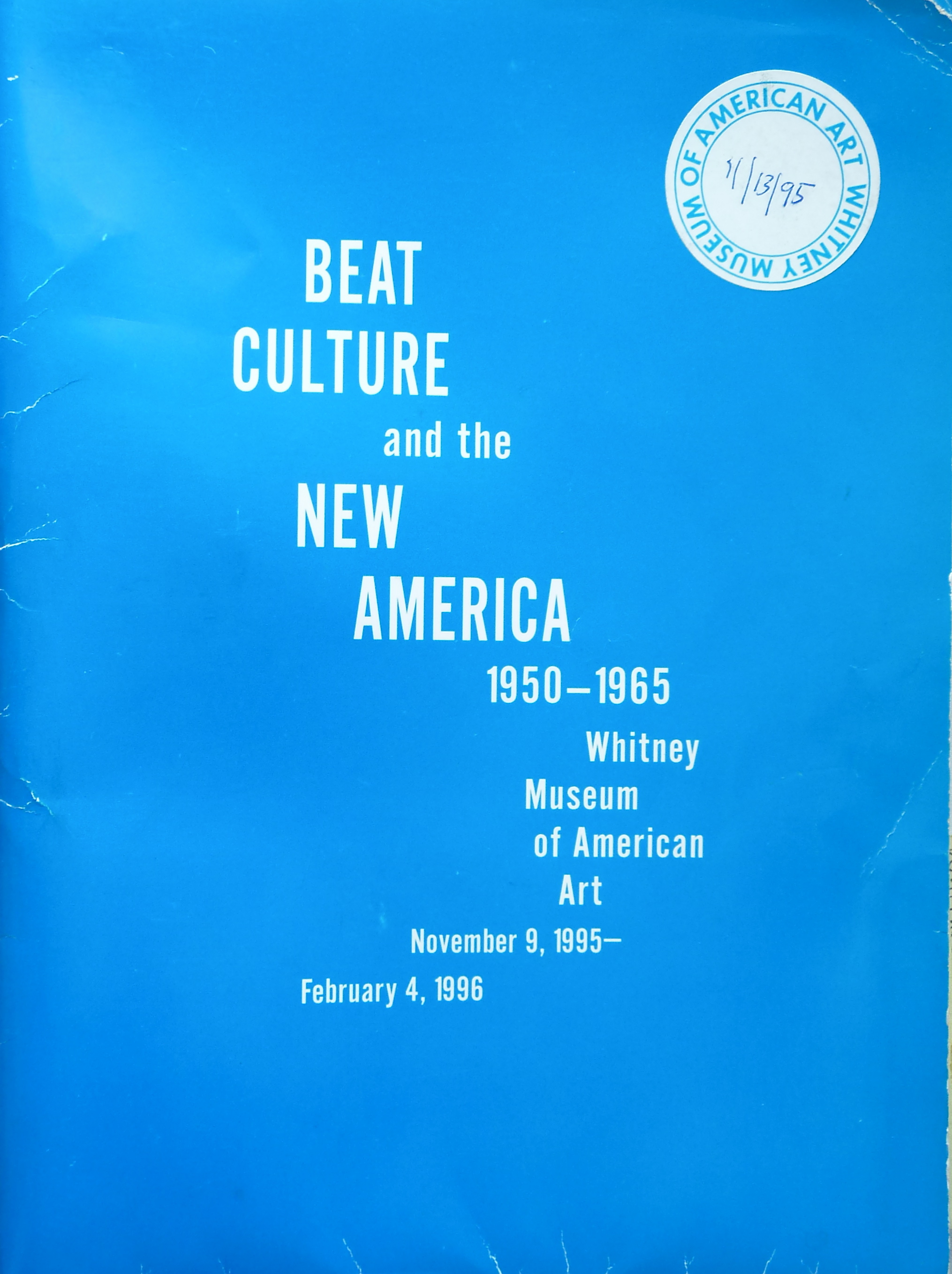
(a feature story from 1995 on the historic Whitney Museum show)
Communities of creative minds exchanging ideas has been a dream of artists from the moment they first walked away from the other apes and got back to the land to set their soul free. The Lost Generation café klatch in Paris was cool, and San Francisco’s garden of flower pot parties in the ‘60s sounded like a hoot — but the most influential confluence since the Danube met the waltz took place in New York City in the late ‘40s and early ‘50s.
“Beat Culture,” the current show at the Whitney Museum of Art in New York City, is currently celebrating this zenith of fun through February 4th.
“Let me take you down, cuz I’m going too, through many fields, who knows what’s real, but I’ll try to point the highlights out.”
With Allen Ginsberg’s audio tour in your ear, the museum’s giant freight elevator doors open, and right in front of you is Jack Kerouac’s original scroll of On The Road, the Declaration of Independence of post-war America that Kerouac wrote in one 20-day chi-channeling frenzy in April 1951.
Kerouac wrote to Neal Cassady, his best buddy and the book’s main character, when he finished it: “I’ve telled all the road now. Went fast because road is fast — wrote whole thing on strip of 120 foot long tracing paper — just rolled it through typewriter and in fact no paragraphs — rolled it out on the floor and it looks like a road.”
This mythical dead sea scroll of rock ‘n’ roll has never been seen in public before, having been locked in Kerouac’s agent’s safe since it was first published. No one ever knew for sure if it really existed, but now we can see that not only does it, but Kerouac’s claim of spontaneous prose is upheld, as this opening of the crumbling unfurled scroll matches virtually word-for-word the final published text.
One endless roll allowed Kerouac to go on one — entering a subconscious trance where the artist was creating so quickly there was no time for regimented thought to alter pure expression. This notion of losing one’s self in the creative act, of flowing in a “stream of consciousness,” was the distinguishing difference between these artists and their contemporaries. While iambic pentameter, photo-realism, and Broadway musicals were lulling Beaver Cleaver’s parents into a saccharin stupor, the Beats were taking a chance on the inside without a script, and it turned out to be the cymbal crash of liberty in the jam of the century.
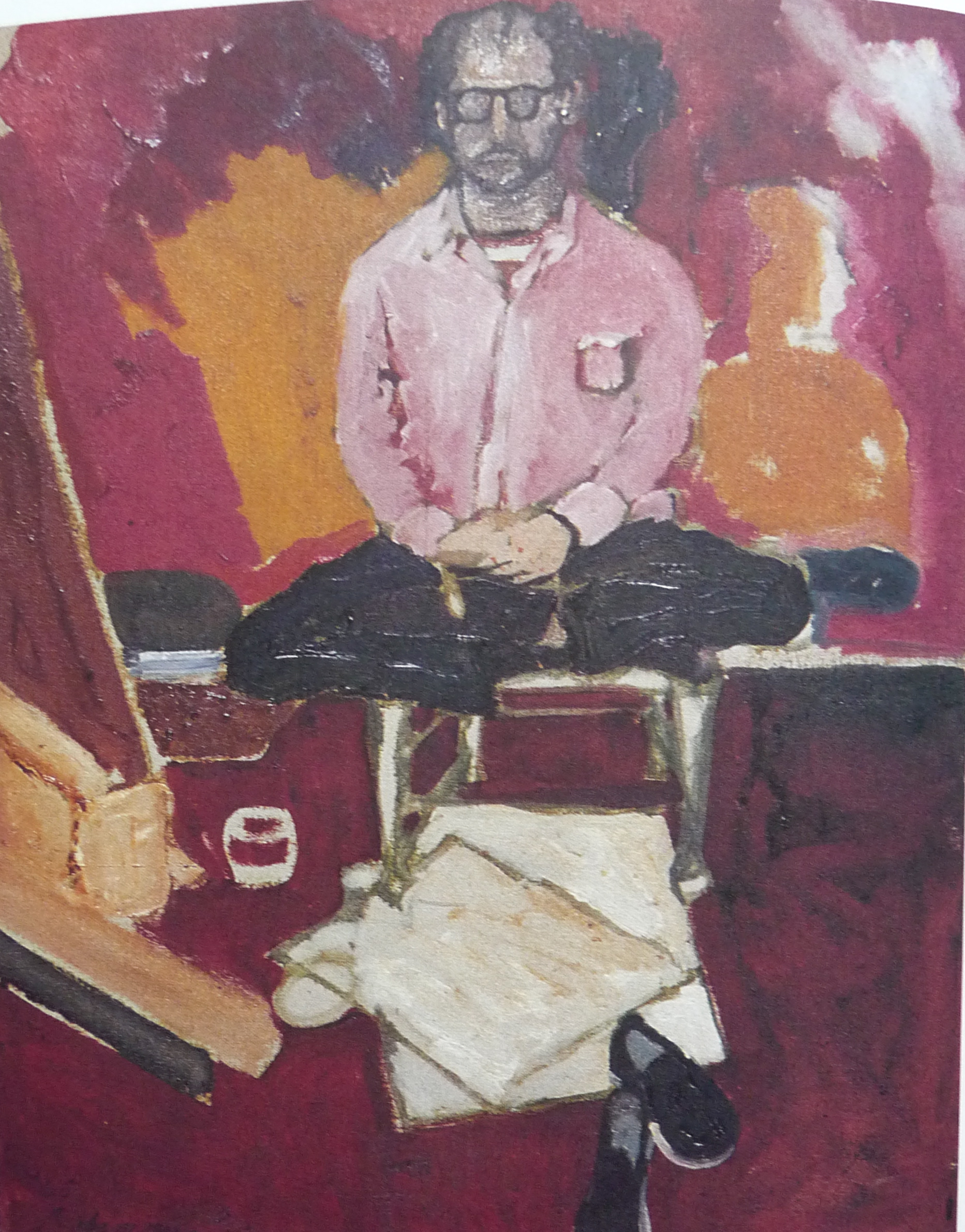
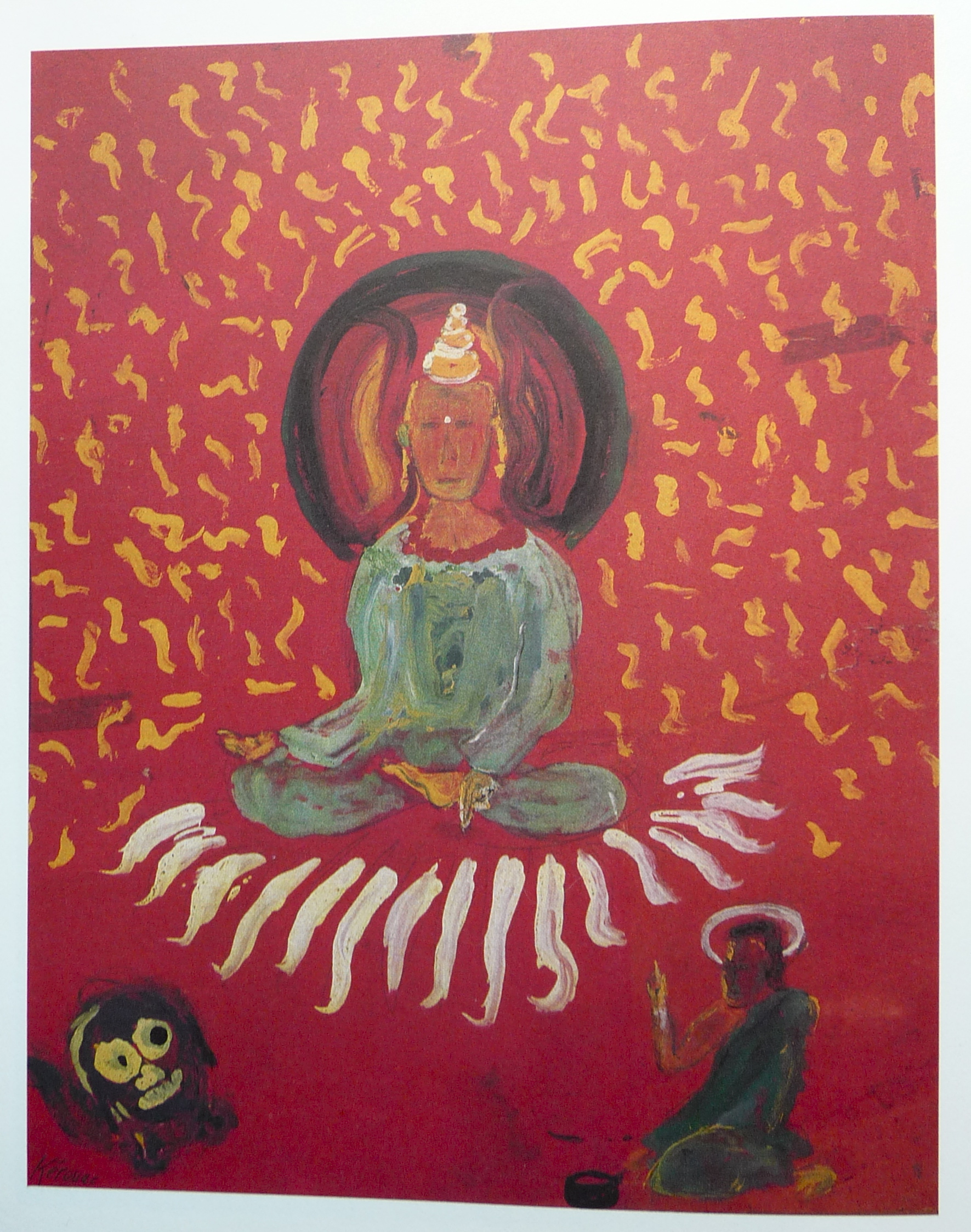
There on the wall is On The Road, and there on the road is a million new bands jamming their way into the future. Beyond the novel’s influence on writers, Ray Manzarek of The Doors put it bluntly: “If Jack Kerouac had never written On The Road, The Doors would never have existed.” After years of being Jim Morrison’s bandleader, Manzarek is now accompanying Morrison’s progenitor, Beat naturalist poet Michael McClure, in one of the most exciting live readings on the current poetry circuit. Besides them performing together as part of the exhibit, many paintings by McClure, Kerouac (his Buddha below), Corso, Ferlinghetti and others show how these writers worked in many media to express the exuberance they felt for life that just wasn’t coming through the Norman Rockwell covers on every newsstand of the decade.
Neal Cassady rapping with the Grateful Dead at the acid tests is also part of the exhibit as a video installation that’s continuously playing in the center of the show, loudly proclaiming the continuum of the Beats into The Beatles into all of rock ‘n’ roll. As Jerry Garcia put it, “It wasn’t a club — it was a way of seeing. It became so much a part of me that it’s hard to measure; I can’t separate who I am now from what I got from Kerouac. I don’t know if I would ever have had the courage or the vision to do something outside with my life ─ or even suspected the possibilities existed ─ if it weren’t for Kerouac opening those doors.”
Although Kerouac was the one who coined the term “Beat Generation,” wrote its Bible and defined its ethos, he secretly wanted “to be considered a jazz poet blowing a long blues in an afternoon jam session on Sunday.” His soaring sentences were taken directly from the Bird songs he was listening to on a nightly basis in Manhattan.
Playing throughout the multiple floors of the exhibit is the music created in the small clubs on 52nd Street or Minton’s Playhouse in Harlem, a nickel subway ride from the Beats’ Greenwich Village and Morningside Heights haunts. Charlie Parker, Dizzy Gillespie, Thelonious Monk and later a young Miles Davis and John Coltrane were blowing apart traditional jazz and improvising solos at double the tempo of the rhythm section. It demanded the perfectly pure channeling of a disciplined voice combined with the courage to throw everything you knew out the window for that one shot at sunburst glory where the golden soul breaks through the clouds and the god-like voice inside all of us comes flowing out in clear honest truth.
Back down on 8th Street, and then later at his retreat on Long Island, Jackson Pollock was busy inventing nonobjective abstract expressionism by going “into” his paintings ─ dancing hypnotically, weaving chaotically, creating quixotically harmonious flows on his giant canvases in a spontaneous trance of focused freedom.
“It was great drama,” a friend of his said of watching him work. “The flame of explosion when the paint hit the canvas; the dancelike movement; the eyes tormented before knowing where to strike next; the tension; then the explosion again.” As Kurt Vonnegut saw it, the reason Pollock’s work lasted was because “it celebrates what a part of the brain can do rather than what pictures should look like.” Or is that Kerouac or Bird he’s talking about? As Pollock himself put it, “When I’m in my painting, I’m not aware of what I’m doing.”
Also on the walls are several photomontages by the godfather of punk, William Burroughs, as well as his paper cut-ups, and Naked Lunch manuscript. And there’s the great New York poet, prankster and artist Gregory Corso, who contributed a hypnotic 3-D collage of every major city in Europe, as well as his notebooks and portraits of people he knew. “Hey!” he yells out at the opening night party. “That’s one of mine,” he says, squinting closer at his Portrait of Robert LaVigne. “Aaaa, doesn’t even look like the guy,” he said, waving his hand. “Come on girls,” as he walks away with his harem.
Over at a loft on 14th Street, Julian Beck and Judith Malina formed The Living Theater, whose photos, paintings, script outlines and filmed performances are part of the show, as they invited artists to mingle in performance and life, encouraging actors to improvise the essence of their characters instead of performing the same lines every night. And speaking of parties, theirs were legendary — there’s photos of Mailer and Ginsberg going at it again; there’s O’Hara, Kline, and Kerouac all drunk again; there’s Mingus jamming with Patchen, and Ferlinghetti reading Coney Island of The Mind; there’s Beck’s collages now hanging on the wall at the Whitney Museum; there’s hope.
And this new style of improv acting starting in New York soon took over Hollywood as Marlon Brando, James Dean & others began improvising many of the best scenes of the decade. Dozens of these gems are playing all exhibit long in the museum’s theater, including Rebel Without A Cause (1955). Dean’s co-star in that, Dennis Hopper, whose private art collection contributed greatly to the show, told the story of how Dean improvised that whole opening scene of Rebel — picking the wind-up monkey off the set and playing with it as a baby might, then wrapping it in a paper blanket. That single bit of subconscious, spontaneous acting has been studied by film students the world over for everything from its personification of the boy/man/baby torn-between-worlds dilemma, to its children-as-wind-up-toys-of-their-parents theory which set the stage for the film’s drama, as well as the generational conflict that followed.
The single coolest document of the Beats is also on view — the 28 min. independent film Pull My Daisy. Shot in 1959 by Robert Frank at painter Alfred Leslie’s loft starring Allen Ginsberg, Gregory Corso, and the painter/musician Larry Rivers. The film was shot without sound then narrated by Kerouac who improvised all the dialogue and storyline in a beautiful poetic funny vocal solo like Robin Williams on a double-shot of Walt Whitman.
It’s hard to fully appreciate what these artists were doing back then because it’s so much a part of our life now. Like soloing. But this was the transition point where Bob Hope, Louie Armstrong and Robert Frost morphed into Marlon Brando, Charlie Parker and Allen Ginsberg. What changed was their perception of the limitations of art. Each of the pioneers in this exhibition took the framework of the novel, play, canvas, or song, and said, “No rules ─ just purely transmit the songbird voice within without restriction but flow forever clear, Sweet Chariot.”
By ignoring the limitations of the canvas’s frame, the paint and painter were free to fly all around it. So too a song in Charlie Parker’s horn, an actor on The Living Theater’s stage, or a page in Kerouac’s typewriter. Not only did Jack eliminate paragraphs and page endings, but traditional narrative as well by telling one elaborate legend that ultimately ran through all of his books, a single story weaving like a double helix through all of life, illuminating truths that were beyond contrived literary pretension. It was joy in art. It was jamming. It was jewel mining in the fifth dimension.
There are historical precedents for each piece of this story — but they never came together in one place. The Italian Renaissance is the obvious comparison for multi-disciplinary revolution, but there’s not many of those cats around anymore. Van Gogh and the Impressionists were onto it, as were William Blake and Walt Whitman in their singing the songs of themselves. Yeats’ trance writing opened the door, and Joyce’s wordplay made it worth walking through. Emerson’s Self Reliance was the hard surface of the road, and Huck Finn walked along it whistling its tune. But that’s jumping continents and centuries. This renaissance took place on the same New York island over the same five years.
And as this historic Whitney show makes joyously clear, these guys were articulating in the late 40’s and early 50’s what we’re still experiencing today. This is the risk-taking avant-garde community’s direct cultural lineage. And this interconnecting story of writers, painters, musicians and actors will go on endlessly like an ever-expanding web site.
Gathered for the first time are the words, paintings, photographs, music and movies from one of art’s golden eras, when Pollock danced, Jack flew, Allen howled, and Bird blew. Some mop-tops copped the name, and the rest of the revolution was televised. But if you want to see how we got here from Ozzie and Eisenhower’s Conformity Generation, the cats are wailin’ at the Whitney through February 4th.
==========================================
For an excerpt from my book about the ’82 Kerouac Conference in Boulder — check out Meeting Your Heroes.
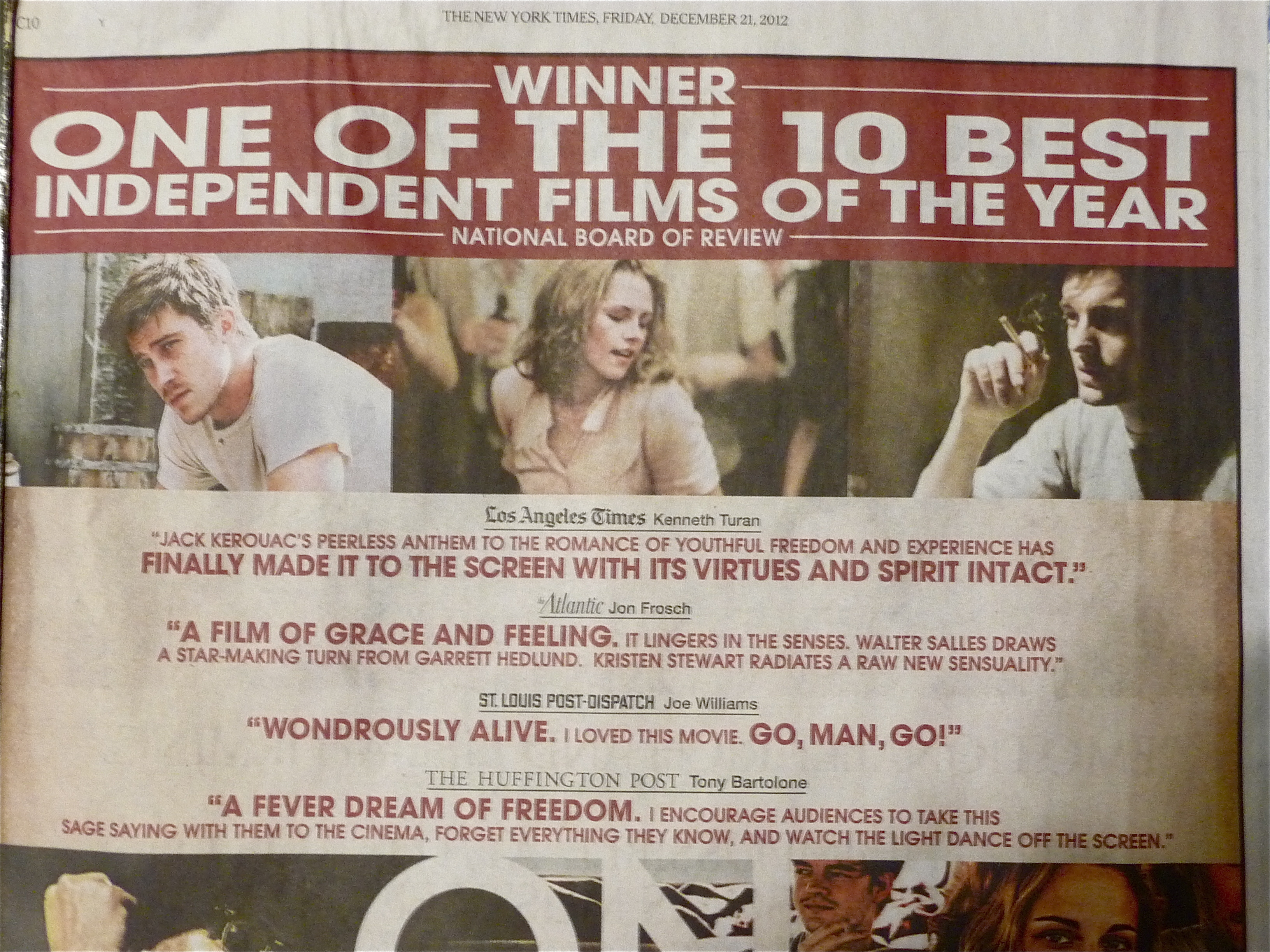
With not one, not two, but three movies based on Jack Kerouac books coming out this year (2013) it makes sense to make sense of the world of cinematic dramatizations based on Beat works.
Since real people are given different fictional names in every movie, for clarity I’ve stuck with the original names of the people the characters are based on.
The Most Factually Accurate / True-to-The-Work Beat Movies (in chronological order) Pull My Daisy Howl
Big Sur
Pull My Daisy — 1959 — the definitive and only authentic Beat dramatization. A film of act 3 of Jack Kerouac’s “The Beat Generation” play/screenplay. This 26-minute movie may be the single greatest Beat Generation creation ever made, in good part because of the collaboration: Jack’s narration is perhaps the best audio he ever laid down; it’s set to a jazzy world-beat score by David Amram; and has the Beat badboys filmed in their prime by a visionary cameraman Robert Frank in an actual Greenwich Village artist’s apartment, typical of where the whole movement was born. It’s based on a real event at the Cassady’s house in Los Gatos in the summer of 1955, which can be read about in detail in ch. 45 of Carolyn Cassady’s “Off The Road.” Directed by Robert Frank & Alfred Leslie — starring Gregory Corso as Jack; Allen Ginsberg as himself; Larry Rivers as railroad man Milo / Neal Cassady; Delphine Seyrig as Carolyn; portraitist Alice Neel as the bishop’s mother; dance choreographer Sally Gross as the bishop’s sister. Selected for preservation by the National Film Registry at the Library of Congress in 1996. B&W, 26 mins.
* This once uber-rare film is now on the interwebs and you can experience the entire masterpiece here or here.
Here’s 5 minutes of silent street & bar footage likely shot by Robert Frank in June of 1959 using the same 16mm camera he’d just shot Pull My Daisy.
The Beat Generation — 1959 — rape-centric Hollywood exploitation B-movie that’s about as pro Beat as “Reefer Madness” is pot; no connection to the Beats except the title and negative stereotypes — dir. by Charles Haas. On the up-side it actually opens with a Louis Armstrong performance! and he also shows up playing again in the middle, and has some dialog. It has a crazy cast including Jackie Coogan (best known as The Kid in Charlie Chaplin’s “The Kid” and later Uncle Fester in “The Addams Family” TV show — and to give you an idea of the authenticity here — he’s also credited with being the beatnik “dialogue coach”!) And speaking of Charlie Chaplin, it also features The Little Tramp’s first son Charles Chaplin Jr. in a bit part as the Lover Boy (the beatnik talking on the payphone trying to pick up a girl). And speaking of famous actor’s children, it also has Robert Mitchum’s dead-ringer son James as the hip-talkin framed badguy; and Bing Crosby’s niece Cathy Crosby completely out of place singing in a white formal evening gown in a beatnik club; segue to Vampira as the female Beat poet with a live rat on her shoulder; and most noticeably Mamie Van Doren (the stage name of the B-movie Marilyn Monroe who Jack actually described his first wife Edie as looking like in Vanity of Duluoz, and no relation to the esteemed poet/author/editor/ Columbia professor Mark Van Doren or his quiz show scandalized son Charles). And she delivers the best line of the movie, purring — “Would you rather be dead with him, or alive with me?” Besides the curious cast, in all its kitschiness and negative cliches it actually has some redeeming themes of sexism, domestic violence, and a subplot and discussions about abortion in the case of rape (which was still illegal everywhere at the time) — but of course it’s just a set-up for an on-screen Catholic sermon. B&W, 94 mins.
Here’s the opening with Louis Armstrong playing & singing an anti-Beat Generation song.
Here’s the 11 mins of Mamie Van Doren’s scenes in nice HD.
Here’s the 4 mins featuring the beatnik club, including Vampira’s poetry reading, complete with a live rat on her shoulder.
The Subterraneans — 1960 — dir. by Ranald MacDougall — abysmal script but an impressive cast — gamely starring George Peppard as Leo/Jack; Leslie Caron (twice Oscar-nominated Best Leading Actress for Lili and The L-Shaped Room, and An American In Paris as “Mardou”; Roddy McDowell as Yuri/Gregory (!); Jim Hutton as Adam/Allen; Arte Johnson as Gore Vidal (!) and a musical appearance by Carmen McRae, the Andre Previn Trio!, plus Gerry Mulligan (with an acting role as well as sax playing), Art Pepper & Art Farmer! Corny, vapid, painfully clichéd, white-washed, neutered, silly interpretation of Jack’s novel, with the Black girlfriend turned into a French girlfriend. (!?) Kerouac’s wildest prose/story/novel is run through a Leave It To Beaver Hollywood conformity filter ending up a cartoon version of the original. Upon re-viewing in 2022 I found the campy portrayal comically endearing — reminiscent of the portrayal of hippies on network TV shows just a few years later. It’s simplistic and watered down and verging on camp, but it’s historically important in that it’s the only example of how Hollywood interpreted Jack in his lifetime (other than the Route 66 rip-off). If it’s any consolation, he got $15,000 for the rights, which was enough to buy a nice house in Northport, the first he ever owned in his life. Another minor positive — there’s some nice location shots of San Francisco captured in the fall of 1959. Interesting little-known tidbit — the LA Times reported in Dec 1958 that Dean Martin was attached to play the Jack part! Never released in any home video format ever. Color, 89 mins.
Here’s the original trailer from 1960. Here’s a scene with some of the jazz with Gerry Mulligan, Art Farmer & the gang.
And this is interesting — 10 minutes of shots from the movie set to Monk & others.
Beat Girl (aka Wild For Kicks) — 1960 — Britain’s entry in the cheap exploitation beatnik field; no actual connection to the Beats except the title and base stereotyping — dir. by Edmond Greville — curious for its bit parts by a young Christopher Lee and Oliver Reed. B&W, 79 mins.
Here’s the entire movie on YouTube.
The Beatniks — 1960 — another terrible beatniksploitation B movie perpetuating the media-contrived image of mean lowlife criminals. It actually has a not bad score, and the story is solid — A Star Is Born gone wrong — but the dialog and every other aspect of filmmaking is absurdly atrocious. As others observed — this is like if Ed Wood made a beatnik movie. 🙂 IMDb Ratings has this at an astounding 2.5! I’ve never seen such a low number in my life! B&W, 78 mins.
You can see the whole terrible movie here on YouTube.
Beany & Cecil — Wildman of Wildsville — 1961 — Since no film festival would be complete without some cartoon shorts — take a break from the serious and enjoy this satire of all things Beat — with none other than the immortal Lord Buckley voicing the lead beatnik, Go Man Van Gogh, and some crazy jazz, daddyo. Color (animated), 6 mins.
You can watch the full clip here.
Route 66 — 1960–64 — one-hour B&W dramatic TV series airing Friday nights on CBS — obviously “inspired by” / ripped-off from Jack’s On The Road — two young men (an outgoing street-wise orphan and a bookish New England Ivy Leaguer who recently lost his father, hmmm), drive around the country having adventures while looking for the meaning of life (Hollywood is nothing if not original!) It was shot almost entirely on location around North America — with 3/4 of the episodes written by show creator Sterling Silliphant (who’d later win a Best Screenplay Oscar for In The Heat Of The Night). Starring George Maharis and Martin Milner (who narrowly beat out Robert Redford for the role). Often compared to the original Twilight Zone, the intelligent adult scripts attracted a mile-long list of now-household-name guest stars — Martin Balsam, Joan Crawford, Boris Karloff, Buster Keaton, Cloris Leachman, Peter Lorre, Lee Marvin, Walter Matthau, Robert Redford, William Shatner, Martin Sheen, Rod Steiger, Rip Torn — to just scratch the surface. They also employed local actors so the dialects were both authentic and different in every episode. Also notable was Nelson Riddle’s music, including the instrumental theme song that actually became a Top 30 Billboard hit in the summer of 1962. Show sponsor Chevrolet saw their product-placement Corvette sales double by the end of the first season! B&W, 50 mins.
Here’s the entire 3rd episode — all filmed in New Orleans in 1960! Unreal footage!
There’s tons of other entire full episodes on YouTube.
Saturday Night Live — 1977 — a TV oddity — John Belushi played Kerouac in one scene in the second season. Dan Aykroyd as a cop brings Jack into Broderick Crawford’s Highway Patrol office. That original show ran from 1955 to 1959, so writing the Beats into the sketch was both a nice ode and made sense. B&W (to mirror Highway Patrol), 2 mins.
Heart Beat— 1980 — written & directed by John Byrum; based on a part of Carolyn Cassady’s autobiography Off The Road; Nick Nolte as Neal, Sissy Spacek as Carolyn, John Heard as Jack, Ray Sharkey as the Allen-like character, Ann Dusenberry as LuAnne; also notable for four weird/cool cameos: Jack’s daughter Jan is the smoking girl in a white dress sitting in the cafe/bar around 11 minutes into the movie in the scene that begins with Cassady/Nolte tipping out of his chair onto the floor; John Larroquette in his first-ever film role playing an obnoxious TV talk show host interviewing Jack; director David Lynch appears briefly as a painter; and Steve Allen pokes his head in the TV studio makeup room when Jack’s in the chair.
Carolyn called this movie “Heart Break” because she hated the final product, but did like Sissy Spacek’s portrayal and as a person. There’s loads of fictionalized liberty-taking and deviations from real events & Carolyn’s book, but it’s a pretty great capturing of the late ’40s/early ’50s era, and deserves praise for its casting, acting, editing, art direction, costumes, and Jack Nitzsche’s fantastically cool score. One little detail they got bizarrely right, undoubtably because of Carolyn’s on-set consultation, they used the real names for the Cassady children, and had kids their ages appear throughout as the three children came into the real life storyline.
Nick Nolte really embraced playing Cassady, and even channeled him into the role he played immediately before this one in Who’ll Stop The Rain — which also starred Ray Sharkey, the Allen character here.
A mistake I’ve made my whole life was taking these Beat dramatizations too seriously — looking at them through a Beat historian’s eye — where they inevitably all come up short. Upon re-viewing in 2022 I realized for the first time that this was crafted as a romantic comedy — in the classic Hollywood tradition. The editing is often done to create comedic juxtapositions — like when Carolyn talks Neal into selling their car so they can move to a house in the suburbs — cut to forlorn Neal riding in the back of the moving truck. Or the refrained cut of the suburban foil couple leaving the Cassady’s house after three successive visits. Think of the scene of the Allen character being oblivious to everyone in a restaurant as he passionately yells out his poetry. Or Jack & Neal happily, obliviously, planting marijuana in the front yard of their suburban house. Or the scene where Jack nervously thinks he’s become Carolyn’s new husband, then Neal literally sweeps her off her feet into his arms and carries her to the bedroom. Or Neal getting stoned when the straight suburban couple comes over and then goofing on them. This film is unique among all other Beat dramatizations in that it has multiple intentionally funny scenes written into it — again, in the tradition of countless 1940s and ’50s romantic comedy classics — the very era this film is set in. Color, 110 mins.
Special Note: Jack’s only child Jan appears 11 minutes into the movie in the white-walled café/bar scene that begins with the Nolte/Cassady character tipping over out of his chair. Jan is the girl in the white dress sitting along the wall on the right smoking, seen in 3 different shots over a 90-second stretch. In her book “Trainsong” she wrote in chapter 22, “In September I was offered the job as an extra in Heart Beat, a movie about my father’s menage-a-trois with the Cassadys. … The Acropolis Cafe was just the place for a beat generation coffeehouse scene: a Greek restaurant in downtown L.A., unchanged since the thirties. … My job was to sit at a table where two guys were playing chess: to follow their moves like a cat, to look mildly bored, … and to puff like mad on Camels to produce a thick, smoke-filled atmosphere.” If you watch it on a screen larger than a phone/computer, you can see that the two men at the table with her are indeed playing chess — especially visible in the third and final shot of them, starting at 12:21. Further, you can google photographs of the interior of the Acropolis Cafe in L.A. and see that it’s where this scene was shot.
You can see a great 11-minute interview with Nick Nolte talking about the film here, including about getting to know Carolyn, and getting to the essence of Neal.
For more details on the production check out this article from the American Film Institute.
Quantum Leap — 1990 — a TV exception — the “Rebel Without a Clue” episode set in Big Sur in Sept. 1958, with Michael Bryan French playing Kerouac in one 2:15-long scene. Also features series stars — the perennially Emmy-nominated Scott Bakula and Dean Stockwell. A screening of this at the “Jack on Film” show at Lowell Celebrates Kerouac evoked a spontaneous round of applause. Color, 2 mins.
You can watch the entire scene here.
Naked Lunch — 1991 — screenwritten & directed by Canadian David Cronenberg (and shot entirely in Toronto); Peter Weller as Burroughs; Judy Davis as Joan Vollmer; Nicholas Campbell as Jack (named Hank); Michael Zelniker as Allen (named Martin; the actor played Red in Bird). Like The Last Time I Committed Suicide, characters based on Jack & Allen are inserted into the story even though they don’t appear in the original text. Plus Ian Holm and Roy Scheider as Burroughs’ recurring Dr. Benway character. Howard Shore (Lord of The Rings, Hugo) does the cool jazzy music, with Ornette Coleman playing. Cronenberg’s sister Denise does the costuming, as she does for many of his films. Title card at the opening says “New York City – 1953.” It’s not really an adaptation of the novel per se, but rather a surreal biopic of Burroughs’ life during the time it takes place in. This was the first remotely popular Beat movie; it swept the Canadian film awards taking home 7 Genies, including Best Picture, Director and Cinematography. Color, 115 mins.
Here’s a 3 minute clip where Bill is walking through a Tangier market talking about writing and killing his wife.
The Last Time I Committed Suicide— 1997 — written & directed by Stephen Kay; Thomas Jane as Neal, Keanu Reeves in a Kerouac-like role (named Harry), Adrien Brody in a Ginsberg-like role, a great Claire Forlani as Joan Anderson, 24-year-old Gretchen Mol playing 16-year-old Cherry Mary, the great Marg Helgenberger (from Erin Brockovich) as Joan’s mother. A really well made film based on the then-only-surviving part of Neal Cassady’s famous Joan Anderson/Cherry Mary letter to Jack (written Dec. 1950) about events around Christmas 1945 before Neal had met any of the other soon-to-be Beats. It’s notable that this is the earliest Beat writing ever turned into cinema. Carolyn Cassady & I agree this is the best Beat dramatization on film. Interesting tidbits: Carolyn Cassady and George Walker both said this Thomas Jane portrayal was the closest to Neal they ever saw on screen; the complete 16,000-word letter, a fragment of which this movie is based on, was lost in the mid-1950s — but was miraculously found intact in 2012 in an old box that had been stored since being rescued from the Sausalito publisher Golden Goose’s garbage when it folded in 1955. The film’s got a bitchin soundtrack, both snappy original compositions by Tyler Bates, plus Bird, Dizz, Monk, Miles, Mingus, Ella & others. It’s got shades of Michael Polish’s Big Sur (see below) with its heavy use of voiceovers of the original text (although with additions and edits) and the cinematic details thereof; and it’s like Walter Salles’s On The Road in that it expands upon the existing text using other Beat writings, except in Suicide’s case they also completely make stuff up like adding Jack-like and Allen-like characters to a story set before they ever met. The acclaimed Bobby Bukowski (no relation) is the cinematographer. Filmed in Ogden Utah filling in for old Denver at last. The film builds to a brilliantly executed beautifully exploding-like-stars climax. The whole last half hour is masterful filmmaking – cinematography, editing, acting, pacing, dynamics, score. Color and B&W, 92 mins. Here’s the official trailer.
Or here’s a cooler trailer.
Or here’s the coolest longest most musical & Beat trailer.
Here’s part of the masterpiece climactic sequence where Neal gets out of jail and goes for a run — featuring the swingin’ soundtrack by Tyler Bates who went on to score over 100 other movies & TV shows, including the John Wick films, Guardians of The Galaxy and a ton of others.
Here’s a nice 6-min interview with Keanu Reeves including why he made the movie, and what it was like doing it and ‘dancing’ with cinematographer Bukowski.
Or here’s an absolutely great 6-min interview with writer/director Stephen Kay and Thomas Jane.
Beat— 2000 — written & directed by Gary Walkow; Kiefer Sutherland as Burroughs, Courtney Love as Joan Vollmer – those two being the focus of the movie; Ron Livingston as Ginsberg, Norman Reedus as Lucien, and Daniel Martinez as Kerouac (although he seems to be completely cut out of the re-cut hour-twenty home video version). Shot entirely in Mexico. A deservedly not-well-received-on-any-level dramatization of Burroughs, Lucien, Allen and Joan’s time in Mexico, including the William Tell killing. Prioritizes Lucien and Joan’s brief affair which is a pretty insignificant and minuscule event to base a film around. Basically an indie low-budget B movie with some respectable name actors, probably because of the subject matter. This and Subterraneans are tied for the worst Beat dramatizations — but this doesn’t even have the 1960 Hollywood kitsch to it. It tries to be serious, and fails painfully. It’s a wonder to me how these things get made. And you think of the months the actors and crew committed to it. I wonder if they know when they’re making it that it’s a disaster and going nowhere? Color; 93 mins in theaters; 80 mins in home video.
Here’s the trailer. Here’s an even cooler trailerincluding lots of the jazzy original soundtrack. Here’s a trailer narrated by the Allen character. Here’s a 5-minute collage of various Lucien & Joan scenes.
Starving Hysterical Naked — 2003 — written & directed by Michael Bockman; Billy Zane as Jack (!). It appears as though it has never been released, and maybe never even completed. Set in 1957 on the cusp of On The Road being published, with Jack looking back at his life. It includes Jack appearing (as “Nick Constantine”) on stage at the hungry i nightclub in North Beach. Billy Zane’s characterization resembles Jack’s appearance in the 1950s more closely than any other on film. Besides the on-stage appearance, the narrative story seems to be a very no-budget amateurish covering of largely the same ground as Kill Your Darlings (see below) — the Beat Gen birth at Columbia.
If anyone knows anything more about this movie, please let me know.
Color and B&W, 9 mins.
Here is the only known clip of it.
Beat Angel — 2004 — director, editor and D.P. Randy Allred; written by Bruce Boyle, Frank Tabbita, Randy Allred & Vincent Balestri; Vincent Balestri as the Jack character, Frank Tabbita as the foil. A quirky, clever, interesting, heart-felt, kind of surreal, sometimes funny, well done, low budget indie movie about Jack Kerouac coming back to life for a night in 1999, with a cool minimalist jazz score. All shot in funky locations, including some neat footage of Desolation Peak and the lookout cabin. The actor who plays Kerouac had been performing him live on stage in a one-man show since 1980. His is the most spirited, joy-evoking, linguistically sharp portrayal of all the actors who take a crack at Jack. The centerpiece performance at the poetry reading in the middle of the film was all shot in one take on the last roll of film they had. (!) Color, 98 mins.
The Great Sex Letter— 2006 — a visual dramatization set to a reading of Neal Cassady’s letter of March 1947 to Jack Kerouac that Jack dubbed “the great sex letter.” Despite the film’s inaccuracies — like the person receiving it appears to be Allen not Jack — this low-budget 7-minute indie effort is notable for being the earliest Beat writing ever interpreted on film, followed closely by Neal’s “Joan Anderson/Cherry Mary” letter to Jack written in December 1950 and turned into the feature-length The Last Time I Committed Suicide (see above). The film begins in silence, then the only audio you hear is the reading of Neal’s words set to music by Charles Mingus. Color, 7 mins.
You can experience the complete short film here.
Neal Cassady — 2007 — written & directed by Noah Buschel; Tate Donovan as Neal (who a lot of people including son John Cassady and myself think did a pretty good job), Amy Ryan as Carolyn, Glenn Fitzgerald as Kerouac, and Chris Bauer as Kesey. The first 15 minutes, shot in B&W, are Jack & Neal looking for Neal Sr. pre On The Road being published — then the rest is post Neal’s arrest during the Prankster years (shot in color). A well-intentioned low-budget ($1 million) film that fairly accurately portrays Jack as the born writer (forever taking notes) and Neal as somebody with aspirations but who gets on a merry-go-round he can’t get off of. Features the only dramatization on film of the historic 1964 Prankster party in New York where Jack and Neal saw each other for the last time. It would be easy to call it bad, and many do, but there’s lots of interesting little accurate details, and Donovan really has Neal’s mannerisms and speech pattern down. B&W and color, 80 mins. Here’s the trailer.
Luz Del Mundo — 2007 — co-written & directed by Ty Roberts; Austin Nichols as Neal (and the focus of the movie), Will Estes as Jack. The dialog is in both English and Spanish, but there’s no captions. Shot on locations in and around San Miguel de Allende. It starts of Feb. 3rd, 1968, the day before Neal’s death, then flashes back to the summer of 1950 with Jack & Neal (and Frank Jeffries/Stan Shepard) on the road. It’s mostly about Neal being pursued by the ghost of death. Only released in Mexico as far as I know. The title translates to “Light of The World,” which is kind of ironic since the movie is pretty dark. Color, 31 mins.
You can watch the full movie on Vimeo here.
Big Sur— 2013 — screenplay adaptation and directed by Michael Polish; starring Jean-Marc Barr as Kerouac; Josh Lucas as Neal; Kate Bosworth as Billie (Jacky Gibson); Patrick Fischler is great as Lew Welch; Anthony Edwards as Ferlinghetti; Radha Mitchell as Carolyn; Balthazar Getty as McClure; Henry Thomas as Philip Whalen; and gorgeous Stana Katic as Lenore Kandel. The second major Kerouac novel released as a movie in a year — and a 180 degree counterpoint vision to the youth and optimism of On The Road. Setting aside Pull My Daisy, this is probably the most accurate portrayal of Jack and his writing on film. Hauntingly shot on location in S.F. and Big Sur, including an evocative mystical cabin set. Definitely the most artfully lensed and edited (visually composed) of any of the Kerouac films. Roughly 85% of the dialogue is voiceover of Jack’s own Big Sur prose. They use the real names for everybody, not the novel’s fictional ones. Beautiful haunting minimalist electric guitar and grand piano score by the Dessner twin brothers from The National. Color, 81 mins.
Here’s an atmospheric 3-minute trailer.
Here’s a more traditional 2-minute trailer.
Kill Your Darlings — 2013 — directed by first-timer John Krokidas; incredible cast — Daniel Radcliffe as Allen Ginsberg; Dane DeHaan as Lucien Carr; Jack Huston (John’s grandson) as Jack Kerouac; Ben Foster as William Burroughs; Michael C. Hall as David Kammerer; Kyra Sedgwick as Lucien’s mother; Elizabeth Olson (the twins’ younger sister) as Edie Parker; Jennifer Jason Leigh and David Cross as Ginsberg’s parents; and John Cullum as the Columbia English teacher. Allen Ginsberg’s coming of age story from entering Columbia through the David Kammerer killing, which was the subject of the early Kerouac/Burroughs co-authored novel And The Hippos Were Boiled In Their Tanks. The film’s title comes from the William Faulkner line, “In writing, you must kill your darlings,” meaning you sometimes have to delete your favorite passage for the betterment of the story. Sadly, the Kerouac character is very much minimized, gay themes are stressed, women are portrayed as shrews, and there’s tons of perplexing factual inaccuracies in a film that presents itself as “a true story.” Color, 104 mins.
You can read my full detailed review from its premiere at the Toronto International Film Festival here.
Here’s the official trailer.
Here’s all of Elizabeth Olson’s scenes as Edie Kerouac to show you how painfully bad the film’s portrayal of women in general is and of the key Beat Generation catalyst in particular.
Here’s the film’s portrayal of the Kammerer murder.
Here’s the awkward 3-minute bar scene with all the principals.
The Subterraneans — 2013 — directed, edited and screenplay adaptation by Simon Benelhady; Oskar Brown as Leo/Jack, Taneshia Abt as Mardou/Arlene Lee. German indie production — second attempted adaptation of the novel after the disastrous Hollywood version in 1960 (see above). The full film doesn’t seem to have manifested. B&W, 4 mins.
You can watch the full 4-minute sizzle reel/pitch tape here.
Kill Your Darlings — set in 1944 (released 2013) The Last Time I Committed Suicide — set in 1945 (released 1997) Heart Beat — set in 1946-66 (released 1980) On The Road — set in 1947-49 (released 2013) Beat — set in 1951 (released 2000) The Subterraneans — set in 1953 (released 1960 and 2013) Pull My Daisy — set in 1955 (released 1959) Big Sur — set in 1960 (released 2013)
The day of the “On The Road” premiere in New York (Dec. 13th, 2012) I was up at the NYPL trying to get through the doors of the hermetically sealed vault of the Berg Collection, home to a gazillion literary papers from Emerson to Shelley — but most importantly the entire Jack Kerouac collection! And when I say “entire” I mean from grocery lists to manuscripts. The book that lists his stuff there is single-spaced and four inches thick! And of course the place is harder to get into than the Oval Freakin Office, but I figured with the mojo of this 12/12/12 opening I oughta spin the tumblers and see what happens.
There’s forms ya gotta fill out, cards ya gotta get, background checks, Jeopardy questions, a swimsuit competition — it’s all way too much, but I jump through every hoop and roll with every punch, and they say they’ll get back to me . . . in a week.
So, I go to the library’s free computers to check my email and find this from the film’s director . . . “Brian, Walter wanted to see if you would like to ride up with him to the premiere tonight.”
! ! ! !
Done.
And then at the same time, I get an email from Teri McLuhan saying she can’t join us as planned — so suddenly I’ve got an empty seat beside me for the premiere night adventure! But instantly, from the NYPL interwebs I’m able to track down The Mighty Debster, my intrepid partner from the MTV daze, the Emma Peel to my John Steed, a dynamic duo that got into every concert or mega-party we ever set our sights on.
“Does Walter want a pretty girl to join us in the car?” I email assistant Gerry.
Two minutes later: “Yes, one pretty girl in the car, please.”
And BOOM weir on.
Back to the Jane Hotel to drop off the day and costume into night,
and before I can get out the door there’s an email telling me I’ve been approved to get into the Berg! I dunno how I dun it — and in 3 hours — but I’m sure it wasn’t the swimsuit competition! So, I float out the door, and make my pilgrimage past John Lennon’s house at 105 Bank Street, and although not a very religious type, I did a cross on my chest and say a little prayer of gratitude to John and The Spirits for lighting my Path.
Then cab it down to Walter’s funky SoHo shelter from the storm, and there’s the limo and there’s the driver and before long, There’s the birthday boy! And we’re laughin and tellin stories, and I’m remembering my Spirit Guide role in this vital mission. As Gerry says, “It’s your infectious enthusiasm.” Everything positive, everything up, on our way to the New York premiere, the last in a loooong series for Che Walter on his North American crusade for truth, justice & the Road.
And of course Deb’s not there yet, and he goes, “You don’t promise a pretty girl and then not deliver. Just don’t saying anything. But don’t promise and not deliver,” he’s ribbin me cuz we gotta get in the car and go, but just then, “There she is! Just a walkin’ down the street singin’ Do wah diddy, diddy-dum diddy-doo.” And Boom weir off in the Starship, sittin back that comfy way you can in limos, almost on beach chairs with your legs stretched out catching rays from the New York lights flashing in the windows like an old projector.
And Walter’s holding these pages of a speech he’s written, but he’s not reading them, just looking down and saying, “I hope I don’t forget anybody. Everybody’s gonna be there tonight … oh man …” And I ask, “What about Steve Buscemi? Is he comin’?” And Walter’s, “Oh my gawd, Buscemi!! Gerry, did we invite him?” And St. Gerry checks on his gizmo, and about a minute later reports he was invited but sent his regrets. And we’re back to Phoosh! as we whoosh through the Sixth Avenue traffic. And I remind him the premiere is being held right around the corner from where Jack birthed the On The Road scroll, and Walter says, “There’s no such thing as coincidences,” and twinkles through the flashing night lights.
And as we turn onto the block we can see the mobs on the sidewalks and the whole scene, and the driver starts to slow down right in front of the red carpet and Walter calls out, “No, no, drive up ahead, don’t let me out here!!” not wanting to step into the flashbulb blitzkrieg. We get our shit together in the darkness of the stretch-Hudson, and then it’s, “Go!” and we open the door and stride as quickly as we can into the theater, people calling, “Walter,” from all directions, and he grabs Deb on one side and me on the other and we were pretending like we were in the middle of some great conversation for the distance between the car and the glass theater doors. Funny, fast, and efficient.
And there’s the girls with the clipboards and the seas part and we sail into the safe harbor of the lobby. Outside were the unaccredited paparazzi. Inside there’s a whole Special Forces unit of them — and this time there’s no getting around it. But we slip behind the photographer’s backdrop for a deep breath and a twinkling jazzed regrouping before facing that first line of cameras both still and rolling, then a whole wall lined with reporters with notebooks and recorders and accreditation around their necks. While hanging backstage I spot the crew’s cheat-sheets — pages with color photos of each of the expected celebs so the door crew know the faces when they appear. Good look-out.
Turns out all the seats in the theater are assigned, so you don’t just get a ticket, you get a specific seat like at a concert. Once Debs and I score our juicy pair, we go pre-scout the venue and sure enough we’re in primetime dead-center, and I see some cat nearabout our seats, and ask how he came to be here, thinkin this whole row will be friends n family, and he said, “I’m a friend of one of the actors.” “Oh, nice. Which one?” And he says, “Garrett.” And I’m like, “Oh great!” And he asks about me, and I start tellin’ him, and he’s like, “I’ve heard of you! You wrote those great pieces. Yeah, Garrett was telling me about you.” And I’m thinkin’, this is going well so far.
So, Deb & I prankster about for a bit, checkin the scene, eavesdropping on anticipatory conversations, looking into the faces of all the beautiful people who are about to go On The Road. And there’s this guy who looks like Michael Stipe who sang at the Hurricane Sandy benefit last night at Madison Square Garden, but I’m thinkin, “Na, that’s just somebody who looks like him.” And I take a roll down the aisles proudly wearing my American flag shirt that later gets raved about at the afterparty for happily waving it in this second term engagement season, and I’m lookin for familiar Beat faces but this is the film bidniss and not exactly St.-Mark’s-On-The-Bowery.
Then finally we all take our seats and I’m makin friends in about four different directions, including with these crazy red-haired girls who keep droppin booze bottles on the clanking floor all night which was really funny and very On The Road but I bet some less-than-spirited patrons may have been offended at their lack of decorum at this serious occasion — but to me they were just quiet Jacks laughing in the immensity of it.
And soon some IFC honcho comes on stage and praises Walter up down and sideways as “a master filmmaker and one of the best cinematic storytellers in the world,” then Walter comes out and he’s all, “Geez, well now I’m really trembling a little after that introduction!” Then goes, “And I’m also nervous to be here because ‘On The Road’ was birthed (he’s using my word!!) just three blocks from here,” And I’m, “No way! He’s doin’ my bit! He remembered!! Cool!” And then he says, “It was written on 20th Street and 9th Avenue in April 1951, and I want to thank my good friend Brian Hassett, who is here tonight, for reminding me.” And I’m, No way!! Not only does he thank me, but I’m the first person he mentions in his New York premiere night speech!! What the?!?!
Then he goes on and talks about the movie and thanks the IFC people and John Sampas and Ann Charters and others but I barely heard it cuz I was still in such a tizzy over he thanked me!! . . . First!! And then he does it again! Crazy! Pinch me!
Walter does all these incredible off-the-cuff riffs covering any number of subjects. Like, “I had a passion for the book that was triggered when I first read it in 1974 when I was entering university in Brazil which was living through the dark ages of a military dictatorship, and the book carried all the freedoms we were seeking but not able to experience, so it had a very resonant quality, but I knew that that wasn’t enough of a reason to begin an adaptation, so I proposed to American Zoetrope to do a documentary in search of a possible film based on ‘On The Road.’ And they went for this insane idea! And for six years we crisscrossed America on the paths Kerouac had taken when he wrote On The Road, and we met with the characters of the book who are still alive and they were extremely generous to us. We talked to the poets of that generation that changed the cultural landscape not only of this country but of Brazil as well. Lawrence Ferlinghetti, Michael McClure, Diane DiPrima, Amiri Baraka, Hettie Jones — it was a unique experience because I had never met younger 70-year-olds than this group, because they had kept two things intact — their beliefs and their integrity. And that’s very very hard to keep in the long run.”
And then he brings out the actors in this cool way — in the order in which they first committed to the film. First it’s Kirsten Dunst who plays the person he met on the project who most impressed him — Carolyn Cassady. “In meeting Carolyn in 2005, I was so impacted by the intelligence and the sensitivity of that unique woman, and I thought that only an actress with those qualities could play her. Please welcome Kirsten Dunst.”
Then he goes into this whole story about a friend of his who saw an advance screening of “Into The Wild” and immediately called Walter about the perfect actress to play Marylou, and he wrote the unknown’s name down on a napkin: “Kristen Stewart” “And when I first met her in 2007 she had such an in-depth understanding of what ‘On The Road’ was about and knew the book inside out, and she was 17.”
Then … “When Garrett Hedlund drove from Northern Minnesota for 3 days to the audition in Los Angeles, he brought such electricity and life to Dean that we knew we had found one of the most difficult characters to cast, and that electricity never dissipated — but what I didn’t know is that he would be such a great Road companion.”
And then he intros Sam Riley with, “One day I saw ‘Control,’ and for those of you who love cinema, you know how impactful that could be. Seeing Sam Riley in that film was something I wasn’t going to forget. There was such intelligence in the performance, such intensity, but also in the non-verbal there was the capacity to understand and decode the world. And these are qualities writers have, and that we wanted to have to bring Sal to the world.”
Then he says, “I have to confess I belong to a specific religion that states — there is no independent film without Steve Buscemi.” Gets a big laugh. “Many thanks to him for helping, not only for being in the film but for recommending so many great actors that we ended up casting in it. You’re wonderful.”
And then the movie happens — my fifth time seeing it on the big screen (!) — and I kinda lost it at the Orgone Accumulator scene. Now that I know it’s coming, I see Viggo as Bill as so freakin funny in this scene, it’s just nuts in the Crazy Dept., and before he ever climbs into that outhouse I’m laughing my head off and infect the rows around me so by the time he finally sticks his head in the window our whole section is roaring.
Then the movie’s over to many whoops and whistles and raucous applause, and it’s one of my favorite times on earth — being in a movie theater right after “On The Road” ends and eavesdropping on conversations and talking to people and looking into their movie screen faces for the story they tell, and of course every face is aglow and the room’s a Marshall stack of fast talking New Yorkers all soloing at once, but you can pick out fragments “… the cinematography … ,” “… that guy who played Ginsberg … ,” “… those party scenes were great!” “… and when he starts to cry at the end …”
And after much beaming Debs and I finally weave out front and hang under the marquee and I ask this group of models what they thought (purely research, you understand) and the prettiest one goes, “AMAZING!” unabashedly beaming, almost giggling in joy.
And we schmooze our way around the circle until the afterglow begins to fade, and it’s like, “Okay, let’s hit the party.” But of course there’s no cabs at the moment you need one, so we mosey on down to 9th Avenue yakkin our fool heads off … What about Kristen Stewart?! and How about that soundtrack?! And Debs is goin’ on about the costumes and how the people look and how they totally brought post-war America to life.
And we get to the avenue and of course there’s no cabs there either, and by now a whole krewe from the movie including the models have caught up with us, and we’d need about 3 cabs anyway, and Deb goes, “It’s really close, let’s just start walkin,” and of course — Bing Bing Bing — “And if we don’t get one by 20th Street, wheel swing past Jack’s house on the way to the party!”
Then on the very first corner there’s this deli and I’m like, “My God! I’m in New York!” And dash in for a cold Heineken Road jar … because I can. And now weir really rollin and I know no fleet of cabs are comin so I start tellin’ the gang the whole story of the 50th Anniversary of Jack writing “On The Road” show I produced — which started by going to this house on 20th and then walking to the corner to find the closest bar and talking them into giving me the place for the night Jack started writing the Scroll. And one of the krewe actually LIVES on this block of 20th and didn’t know this was The Street!
And just as the tour bus is approaching the sacred site, I see someone go up the stairs and through the door! I scootch up ahead and somehow get the guy’s attention, and he’s squintin through two sets of doors at this maniac at his gate, then I start waving him out and gosh darn if he doesn’t come!
“Hey man! You know who used to live here?”
“I sure do,” the shy guys says.
“Well, we were just at the premiere of his movie! Of the book that was written right here in this apartment!”
“You’re kidding?! The premiere was tonight?!”
“Yeah, it’s great, you’re gonna love it. Hey — what apartment are you in?”
He points up to the second floor, “Right here in number 2.”
And I fairly yell, “THAT WAS JACK’S APARTMENT!!!”
And he goes, “Yeah, I know,” and smiles a twinkle.
I figured he didn’t want to have our whole krewe up to his place without any warning, so we just blessed him, and thanked him, and buzzed him, and left him with a big glow as we continued our flow to the aftershow.
And Aretha’s flyin through my head — “This is the house that Jack built, y’all, remember this house …”
“I stopped at John’s place on the way to the premiere, and Jack’s house after the premiere!” I’m gushing like a geyser and dancing down the street like a dingledodie delirious with everything at the same time and spinning like a centerlight top, and everybody goes, “Awwww … that Brian guy’s nuts!”
Then we get to the corner of the party, and now Deb starts jumping up and down! “Oh my God, it’s at The Top of The Standard?!?!” and starts screamin and laughin and yankin on my arm like a little kid about to go on her favorite ride!
Everything had already taken on that surreal tone of a night in magic places in endless New York … and we hadn’t even gotten to the playground in the sky yet!
And just as a last throw-ya-off and freak-ya-out before you step into Netherland, the elevators have those crazy mirrors, and trippy lights, and the girls are gorgeous, and the guys are crackin jokes, and we’re travelin straight up at the speed of light.
BOOM — into the Gilded Age, in a place that looks for all the world like Windows On The World at the top of the World Trade Center — a high-rise along the Hudson with no buildings out the windows — because it’s in the West Village you can just see forever out the vertical frames of floor-to-ceiling glass. And there’s Walter being the gracious host, greeting everyone at the door as they arrive, and I tell him about the pilgrimage to Jack’s house and meeting the current resident, and he’s shaking his head, “Only you, amigo!” And another big hug and cheek kiss and wild night with the mad ones was just beginning.
Then he leans in and tells me Patti Smith was at the movie, but he doesn’t know if she’s here at the party or not.
And I’m like, “Got it.” Boom: Mission Patti. Find her in about 3 secs. Back to Walter. “She’s right there by the window,” I nod. He smiles. “Anybody else you want me to find?” We laugh, and I’m off to the party.
And right away his saintly assistant Gerry goes, “Oh, there’s something Walter asked me to give you,” and pulls out these magic beans — tiny “On The Road” buttons based on the orange-covered first edition I ever owned!
And I wander a few more feet and there’s ol’ John Sampas … and we’re all super friendly. I know bad shit’s gone down, but he was really helpful to Walter and the film, and I thanked him for that, and he was all wide smiles and really liked how the movie turned out.
And there’s Hal Willner the forever music supervisor of “Saturday Night Live” and movies like “Howl” and “Gonzo” and also produced a bunch of Allen and Burroughs’ albums, and posthumous Lenny Bruce and Edgar Allen Poe, and so he’s right in with the family of crazee Roadsters, and we jammed on the fragments of lost memories in the mindfield landscape.
And then there’s Ann Charters and Regina Weinreich at a nice corner table overlookin the city, and just like the movie — the women are most prevalent.
And after scouting the room, I realize the headliners’ section was that sunken booth area by the front door, and as I head down into it I overhear the undercover security protecting the stars saying, “He’s okay, I saw him with Walter,” and Boom — I’m in. And there’s Garrett beaming, and we finally talk, and he knows who I am, but he’s still in official promo mode, all polite and by-the-books, but a while later I spin back and he’s got a pack of cigs in his hand. “You goin’ up for a smoke?” The eyebrow high-five, and weir off.
The Roof! I’m Home! They have a whole closed-in heated plastic room up there, but the real scene is the wide open spaces — most of the entire roof is a giant party space with views in every direction around this port city, and weir just blazing as the night starts kickin’ in, and Kirsten joins us, and some director doing Garrett’s next movie, and Debs is there refraining Amsterdam, and we’re finally havin’ a yak about all things Beat, and Garrett tells me the two scenes he had to audition for the role were the suicide rap and the 4-way sex letter. I guess Walter felt if you could deliver those two solos you could be in the band. And I flashed back to Walter saying how he loved Garrett’s acting but didn’t know then what a great road buddy he’d turn out to be.
Then after a smoke or three we start headin’ back down the stairwell to the party, but up comes brother Ben and Katia, Garrett’s friend couple from our row at the premiere, and suddenly weir having this reunion on the landing of a stairwell with a glass wall behind us facing uptown New York City, and a party ensues, and then Boom, Sam Riley appears at the top of the stairs, and Garrett goes into an incredible Sam impersonation, and MAN has this guy got the gift for it!! He does Riley better than Riley. And suddenly Jack and Neal are together again hangin’ in the stairwell, riffin off each other 50 years later. And THEN Kristen Stewart comes walkin down the stairs, and suddenly it’s the whole Road crew! hanging on a stairwell balcony, only missing Big Al Hinkle, who we could see on the street below running out for more rolling papers, as weir looking over twinkling New York with Neal carrying on multiple conversations in multiple voices at once.
And then back to the party and Walter introduces me to Kristen Stewart, which is such a strange and unexpected thing that he has to be dealing with with this movie. Like, nobody in it was supposed to be a movie star. The leads were all cast because they were unidentifiable fresh faces — film goers were already coming in with such fixed images in their minds as to what the characters looked like, the filmmakers couldn’t also have actors with established characters affixed. So they cast all relative unknowns in the main roles. Then lo and behold, Kristen Stewart becomes the biggest grossing actress of 2012 before the movie even comes out. So Walter, and her, and everyone, have to deal with this.
But I get to hang with the mega-star for a while, and man, she’s so petite you could put her in your pocket! And she’s bookish, and reserved, and 180 degrees different than Marylou. We talk about indie film, and she confirms my assumption that’s she’s gonna do them the rest of her life. We didn’t say it, but this is a 22-year-old indie chick who fluked into the biggest movie franchise of the last few years and she never has to work another day in her life. Yet she is going to be so many different interesting characters in the years to come. I tell her the truth that she brought Marylou more to life than Jack did, but she would hear none of it. To her, it was all Jack. And I beamed.
Then back to the center bar with windows out three sides, and now it’s lookin’ like The Rainbow Room, and all New York is spinning, and there’s the krewe from the Jack’s house walk! And we start riffin’, and I pull out my scroll book, and they start jammin and reading passages from it, and then 20th Street homie sez, “You got a favorite part?” and hands me back The Bible and I play some boppin’ “Hearing Shearing” in the bull’s-eye center of the room, Jack’s voice in the house, and the whole krewe whoopin’ and the Gold Club bartenders bug-eyed, and the neighbors nodding, as the bass player hunched over and thrummed the beat, faster and faster it seemed! And oh, Mighty Jack — his songs still singin’ and swingin’ above old New York …
And suddenly there’s Walter! And we hug and he says he has to go find somebody and I’m “Okay,” and we wander off on some mission. I dunno what we were doin’ but we ended up on the roof and back again and I dunno if we ever accomplished anything but I told him, “Your kids are all gathered in the corner — you should go see them.” And this was the most amazing thing — in this beautiful penthouse skyline scene where I would not and did not take any pictures except for the one I’ll share shortly, but in the corner of this mobbed premiere party, Garrett, Kirsten, Kristen, and Sam were able to sit side-by-side in this alcove by the window, the four of them together again for perhaps the first time since they were all crammed in a ’49 Hudson for months, and able to enjoy the reunion together. And it’s so obvious how close they all are — it was like my high school reunion of a couple years ago — talkin, laughin and huggin all at the same time.
And like a high school reunion, things started to get crazy, people were making out, people were disappearing, people were reappearing, and all of sudden I’m talking to Michael Stipe, and he’s a leprechaun, and I ask him how it felt to be out on stage at MSG last night for the first time in years, and he kind of avoids the question, then I ask him again, and he says he hadn’t planned to do it, and then I asked him again how it felt to be out there on that stage, and he looked away. Then he smiled a beam and looked back and twinkled, “It felt good.”
And then Patti Smith comes by and we chat for a bit about the old St. Mark’s Church scene, and she says it’s still happening, and then Walter shows up and we form a trio, and I’m like, “Wait a minute,” and I pull out the camera and capture these two artists gushing over the others’ work.
And they had a great long one-on-one, and she called the movie “authentic” and that’s the kind of thing you want to hear from someone who knows the meaning of that word.
And then there was the part about … I hated that I was comped and on-the-list for this whole thing. There wasn’t a single sneaking in prank involved anywhere and I hadn’t really broken a serious rule all night as far as I could tell.
But then the party was suddenly over, and all these strange people were streaming into the club who weren’t at the event … and ol’ fast-thinking Deb, Master Of All Things, gets us to boost a booth from the sunken celeb scene, then scores a bucket of fresh ice from one table, and a bottle of juice mixer from another, then I dump out a glass full of stir-sticks for a clean one, and she does the same from the next table, and before long we’ve got a booth and a stocked private bar overlookin Manhattan with a nearly full bottle of Grey Goose that Deb says would be $400 to be sitting here with.
And the staff comes and cleans up the other booths all around us to a pristine club-opening state, but our scene looked like New Year’s Eve at 3AM, with two happy semi-sober streamer-covered revelers still poundin them back.
And from this well-stocked cockpit, the last Beats holding the fort saw out the night, overlooking the twinkling Christmas of lower Manhattan, curved booths at our back, an open bar at our knees, and more stories to tell than we could ever get through.
————————————————————————————————
For a story about the London “On The Road” premiere at Somerset House — check out this sex & drugs & jazz.
For a great story of the world premiere of the new shorter final version of “On The Road” — check out this Meeting Walter Salles Adventure!
For an excerpt from my book about the ’82 Kerouac Conference in Boulder — “The Hitchhiker’s Guide to Jack Kerouac” — check out Meeting Your Heroes.
Some Favorite Moments, Classic Quotes and Lasting Images of the 2012 Campaign,
roughly in the order they happened …
— The ever-increasing availability we all have to unlimited polling data, particularly at RCP and 538.
— The sharing of funny images and insightful articles on Facebook — like having your own customized clipping service by friends from all over the world.
— Looking forward to 11PM for Jon Stewart’s take on the last 24 hours.
— Michele Bachmann getting laughed out of the race by the voters of Iowa and going home after one contest.
— Newt Gingrich’s, “It obvious to any thinking, independent observer that I’m going to be the Republican nominee.”
— Moon bases.
— “Oops.”
— All 9 9 9 things Herman Cain said.
— Everything Rick Santorum said.
— “I’ll bet you $10,000.”
— “I like being able to fire people.”
— “I’m not concerned about the very poor.”
— “Middle-income families make around $250,000 year.”
— “I’m not familiar precisely with what I said, but I stand by what I said, whatever it was.”
— Being in England when he told the country they were not very well prepared for the Olympics and seeing him become a running joke on the tabloid covers and cartoon pages for the rest of the summer.
— And him trying to be witty answering a voter’s question about unemployment: “I’m also unemployed.”
— The New Orleans Musicians for Obama concert.
— Donald Trump cementing his reputation as a wholly demented buffoon.
— “We’re not going to let our campaign be dictated by fact-checkers.”
— “Legitimate rape.”
— Senator McCaskill: “This Akin guy is so far to the right he makes Michele Bachmann look like a hippie.”
— “I love this state. The trees are the right height.”
— And of course Lindsey Graham’s classic “We’re not generating enough angry white guys to stay in business.”
— Clint Eastwood and the chair.
— Then his later comment to “Extra,” “Anyone who asks me to speak at a political convention is an idiot.”
— Jon Stewart’s tag line for the RNC in Tampa: “The road to Jeb Bush 2016.”
— Bill Clinton’s hour-long improvised speech at the DNC.
— Watching any and every appearance by The Big Dog after that — seeing the master back in his element.
— “Don’t boo. Vote.”
— The whole week that the “47 percent” video came out.
— Mitch’s “Nostrahassett.”
— Ryan getting booed to his face at the AARP convention.
— Dave Letterman’s ongoing refrain “Just don’t vote for him” after Romney would never appear on his show.
— Watching Paul Ryan getting challenged by Chris Wallace on Fox and saying he doesn’t have time to explain how their tax cuts add up.
— Hearing Rush say, “If Romney doesn’t win this election it’s the end of the Republican Party.”
— The Democrats Abroad’s debate watch parties in Toronto.
— Malarkey.
— “Please proceed, Governor.”
— “Binders full of women.”
— And Bob Schieffer making fun of Romney, cutting him off to end the final debate with “I think we can safely say we all love teachers.”
— Bruce Springsteen.
— Katy Perry’s form-fitting ballot and “Forward” rubber mini-skirts.
— All the early voting numbers.
— “When a pregnancy occurs during rape, it is something that God intended to happen.”
— Tina Fey’s “If I hear one more grey faced old man with a two dollar haircut explain to me what rape is, I’m gonna lose my mind!”
— Romnesia.
— Axelrod’s “I’ll shave off my mustache that I’ve had for 40 years if we lose any of Pennsylvania, Minnesota or Wisconsin.”
— Governor Christie’s praise and embrace of Obama.
— Watching Obama’s poll numbers rise as Sandy’s waters receded.
— Romney’s Jeep-jobs-to-China doubled-down final lie ad.
— Joe Biden’s “It’s Daylight Savings Time tonight. This is Mitt Romney’s favorite time of year … he gets to turn the clocks back.”
[This piece originally appeared in different forms in numerous publications following these events of May 22nd, 2001.]
.
Part I, The Author’s Song
The passing of the scroll … It’s gone to a good place …
. . . with an iconoclastic, white-tie wearin’ John Lennon lovin’ “huge Bob Dylan fan,” spirit of the 60s, buddy of Brinkley’s, crony of Thompson’s, and owner of the Indianapolis Colts (my new and forever favorite team), Jim Irsay.
It was football that got Jack out of Lowell, and it was football that saved his holy scroll.
… it’s late in the game, the secret weapon, a long bomb from Brinkley caught on the 2 million yard line by Irsay fresh off the bench, dodges past Sterling Lord on the 1 yard line — touchdown!
$2.2 million dollars — a new world record for an original manuscript, more than Joyce’s Ulysses, which some people think is a pretty good book, more than Kafka’s Trial, and every other literary manuscript ever sold. In fact, it comes to about $2,430,000 when you add in the commission and taxes.
I’d tell you about visiting the scroll Four out of five days you could see it unrolled, But I’ll save that for some other time Cuz the essence of the moment is the auctioneer’s rhyme …
I went over to Christie’s at Rockefeller Center across from NBC and next door to The Today Show at about 11:30AM to register so I wouldn’t have trouble getting in later. They asked me how much the bank could clear me for. I wrote down some absurd amount, which actually was my accumulated debt, now that I think of it, not my plus column. So I was literally sweating it out in the humid high noon heat till the Christie’s cutie came out and said, “I can’t get anybody on the phone at Citibank. They keep giving me the runaround. Here, just sign this Credit Check form and here’s your paddle.” Whoopee Cushion! I was in! Swingin’ paddle #427.
Returning around 2:45, I walked again through the opulent and decidedly un-Beat Christie’s Palace past the 6-foot wall mountings of animals in foliage like 3-D Rousseaus, and climbed the ornate inner staircase two cushioned steps at a time until my bean crested the second floor and I immediately saw a mob filling the doorway and spilling into the hallway from the auction room (oh-oh!), the same as where the scroll was displayed. I squeezed through like I had a seat, got to the front of the mob (something I seem to have a knack for) and lo — there it was — the packed in-action auction room! There were 120 seats, all filled, about 25 people standing on each side, so maybe 175 in all, plus 12 Christie’s suits manning rows of telephones on either side of the rectangular room, and about 20 people in the press corral at the back with five major camera set-ups, but none with network logos.
There were several assorted Sampases, Doug Brinkley, Sterling Lord, Ann & Sam Charters, Regina Weinrich, Michelle Esrick, Ed Adler, and scattered throughout was the hard core group of five of us who were there at closing time on the last visitation day: photographer Aaron Schuman and writer Ken Caffrey in the press pen, writer Ronna Johnson who’s coming out with a second take on Women of The Beats later this year, and New York Beat guitarist Randy Hutton who we’ll be hearing more from before long. Others too in the eternity of it.
And I’m there tryin’ to figure it out — who’s with who, what’s goin’ on. It’s Lot number 242 when I came in. Jack’s scroll soul is number 307. A guy gets up from a seat in the back row right in front of me. I hesitate maybe 10 seconds, then step forward before someone else reaches their courage threshold and I ask the next seated person if he’s gone for good and get this rich suit’s disdain, “I have no idea.” Which I interpret as Snagged! Homie’s home. Howdy doody and a whole lot more!
Part II — The Auctioneer’s Song
There are rows of people and the flashing of paddles as the auctioneer speeds through oodles of numbers, pointing out bidders like a presto allegro conductor. But — Sure looks like it’s goin’ to a telephone bidder, I think immediately, as they’re lined up like stoic, somber six-gun shooters facing down each other across the room, concentrating, in their zones, conferrin’ with the coach on the phone-gun, “When do I pull the trigger, chief?”
The bidding increments are all predetermined. Over $1,000, each next bid is $100 — so if you bid, that’s your bid — you can’t pick an amount. Over $5,000 it goes up $500 with each bid. Over $10,000 it goes up $1,000 every time. Over $1 million it goes up in $100,000 increments. When it hits $2 million it starts going up in $200,000 steps. But by then it’s startin to get outta my league.
Up above the auctioneer is an electronic board that lists the lot number and current bid in US dollars. Below that are lines with each country’s equivalent monetary value — so as the auctioneer’s zipping up the numerical ladder, all these foreign currency values are flapping by like the track-changing sign at Penn Station. Euros, UK pounds, French francs, Swiss francs, Deutsche marks, yen and lira in 000s, and the good old Canadian dollar squeakin’ in on the bottom line. (We exist! In fact, in a general sense, there really was one of those “we exist” feelings in the room. It was the magic zing of the old Jack ring!)
So the auction’s goin’ by lickety-split. Lot 249, a copy of Ulysses signed by Joyce himself and by — get this — Matisse! (Who I always remember for saying, “Work cures everything.”) “Okay, I’ll open the bidding at … 5 thousand, 55, 6 thousand…” and 20 seconds later, “Sold for 13,000 to paddle number 319 in the fourth row.” And it all happens in less than a minute. The big ones take maybe a minute and a half, but lots of stuff’s goin’ for under 10 grand, all sorts of little things, no idea what they are, but I felt like bidding just ’cause they’re so cheap. Hey — I’m cleared for it! It had to be something cool, right? Some Emerson thing. But there’s the catch. You can’t scratch your nose or anything. Like, if you move your arm you might be bidding. Then of course your nose would get itchy, and you’d have to turn away from the auctioneer like he’s the teacher and sneak a scratch.
So you’re watchin’ your moves, watching the crowd, and watching these people watching their catalogues and marking in scores and bidding up to a certain point on lots, and then when their last item of the day is gone, they immediately get up and leave. Professional buyers. People with money. A set of Oxford dictionaries goes for $850,000! (And I bet it’s used.) An autographed copy of To Kill A Mockingbird for $18,000. I keep wondering, Who are these people? The guy who’s sittin’ next to Brinkley gets up and steps out for a minute at about lot 270. He’s a big guy wearing this striped suit like I don’t know what, 20’s gangster? 40’s hipster? I don’t know. Big white tie on big black shirt, hair greased straight back, almost like a football player but with a cuff-linked Four Seasons polish and rock ‘n’ roll swagger.
By the time we get to lot 300 there are only four gunslingers left on the sideline phonelines as the auctioneer’s still rattlin’ through numbers like he’s unloading on Bonnie & Clyde’s car, ratta-tat-tatting by the thousands, 19 thousand, 20 thousand, my whole life savings and worth flashing by in split seconds for some piece of autographed paper. Holy Zippers! “15 thousand… 24 thousand… 45 thousand, fair warning at 45 thousand… sold for 45 thousand to paddle 474.” An Edith Wharton letter goes for only $800. Bargain. Musta been a crummy letter. “Went for a walk, love Edith.”
“Lot number 305 — Oscar Wilde, The Importance of Being Earnest, one of only 12 orange paper copies like it, inscribed by the author, opening with a tie bid at 15 thousand dollars, somebody want to break it? Thank you, 16 thousand dollars, 17 thousand…” etc. Goes to 60,000 in 60 seconds.
Part III — The Bidder’s Song
Then comes, “Lot number 307. The Lot a lot of you have been waiting for…” (Ha-ha, a little auctioneer’s humor.) “Jack Kerouac’s original typescript scroll of On The Road, shown here before you on the screens. I’ll start the bidding at 650,000 dollars on this…” (I’m out.) “650,000… 700,000… 750,000… 800,000… 850,000… 900,000… 950,000… 1 million dollars over here, one million dollars in the front row, 1,100,000 dollars… (pause) 1,200,000… 1,300,000… (pause) … 1,400,000 (over the phone) then quickly 1,500,000… (pause)…” And all this time it’s Brinkley’s buddy who’s flashin’ up his white paddle #479 as soon as anyone else bids anything — the old Instant Paddle Flash Routine — then after a pause the front row finally bids again. “1,600,000… (then quickly) 1,700,000… (pause) 1,800,000… then Boom 1,900,000… (extended pause)…” It’s totally silent in the room, of course — you could hear a dream pop. “We can wait a little bit,” the animated auctioneer allowed. “1,900,000… (long pause)… The bid is 1,900,000 with the gentleman… 1,900,000… Anybody say 2 million?” He looks down at the front row and says, “No, I’m sorry, 2 million’s next… 1,900,000… 1,900,000 then? In the third row at 1,900,000… (pause) Is there any further advance at 1,900,000? (pause) Fair warning at 1,900,000…” He raises his little wooden gavel stub and slowly begins to bring it down. “Last call… (suddenly —) 2 million!” he exclaims and points to the front row! Whoa! Then instantly — “2,200,000.” The whole crowd whoops — huge tension release — laughing, clapping, but all the way pinning-the-needle then totally quiet again in about 2 seconds — flying by fast as be-bop! “Anticipation!” says the auctioneer, articulating the air of the collective moment. “2,200,000… 2 million 2… (pause) At 2,200,000, in the third row. Are we all done at 2,200,000? (pause) SOLD! At 2,200,000!” And the whole room just explodes in applause! Huge release — K’BAMM!
And just as the applause is dying down, the auctioneer steps up again. “Ladies and gentlemen, I’d just like to announce that that is a new world record for a literary manuscript at auction.” And another round of cheering and whooping!
Then, in The Funny Beat Thing Dept., as soon as the final clapping dies down, some guy yells, “Corso lives!” and throws his fist in the air. This might not have worked in the middle of the auction, but it was pretty funny in the weird million-dollar-air-void afterwards to hear a voice hollering through the twinkling cosmos, “Corso lives!” He certainly does.
And 2 million dollars says, so does our man Jack.
It was all decided in under two minutes. And as soon as it was over, I bolted up front, and the first sign I had that everything was okay was Doctor Doug grinning so wide I thought his face would snap! Brinkley beamin’ like a baby was all I needed to see. If he’s happy, I’m happy. This must be a good thing!
I said a quick hi to Michelle Esrick and Casey Cyr, the only two other groovers who were at both the downtown On The Road show that I’d just produced at the Chelsea Commons on the 50th anniversary of the scroll’s birthday and also at the uptown auction where it finally would get its wings and leave its New York home for the first time. Jack’s tracing paper science project has outlived him. When I spoke to David Amram on the phone afterwards he was getting kind of choked-up about it — that Jack died with $83 in his pocket, and now just 30 years later, the notebook in that same pocket was worth more than he was.
And it turns out that the striped-suited football player who’d walked by earlier was the guy who bought it! He was all red-faced and excited and stunned — and he wasn’t goin’ anywhere. So I walked over and there was an AP reporter there asking him questions — but it’s about … football … ?! Huh? It’s so weird to think there may be something bigger in this guy’s life today than buying the On the Road scroll for two million bucks. At least that’s what the AP guy was opening with. He was talking divisional realignment with the retractable-dome blues again, and it was like — Weird Scene Channel Surf. Where’s the remote? Switch back to the Jack Epiphany Channel, eh? Sudden click and Irsay’s laughing, “Yeah, it’s been a busy day.” And while he’s laughing a few other reporters surround us, then some big cameras, other people, boom mikes floating in overhead ….
How does it fee-eel?
Part IV — The Acquiring Mind’s Song
“Well, ya know, it’s just… it’s exciting. Ya know, I look at it as a stewardship. I don’t believe that you own anything in this world. It’s dust to dust. It’s something that I take as a responsibility, being a writer myself, knowing the sweat and the blood that went into creating something like this, and knowing how much people love the piece — that’s all very important to me. Having the football team, how our fans love and cherish that. It’s the same thing with something like this. It’s great for Jack, right now, wherever his spiritual vibes are floating around, that he can be fulfilled, because as a writer, there’s always this seed of doubt you have. You know, is it good enough? Is it worthy? Can it stand up with others? And a lot of times great artists end up dying before they ever find out what great artists they were. In his case, obviously this got published but it left him a little bitter over some of the rejection, and so what a great honor for him that he and the manuscript can be celebrated today.”
“What would he think of his work coming out of storage and selling for a record amount?”
“I’m sure he’d be just flabbergasted. It’s exciting for me — that my grandparents got off the ships from Hungary and Poland right here at Ellis Island with nothing but the clothes on their backs — and you know, that’s what this country’s all about. And I think he would be amazed. These days, people — more so than 50 years ago — if you think you have some talent, you don’t throw anything away. Like John Lennon, you know, I’m a big Lennon fan, and he used to curse his aunty, ‘You’ll regret throwing my drawings away. They’ll be worth something someday.’ So now of course everything is kept and treasured. I think there’s a lot of great intrigue with this, tying in the Beat Generation and Cassady, Burroughs, Ginsberg, those guys had a huge influence on the cultural revolution in the sixties, and people like The Beatles and Bob Dylan, they had such a big influence, and to me that’s really exciting — to be able to rub shoulders with the seed planters. The flowers are always beautiful, but the people who planted the seeds, the people who, in their time, had a way of looking at things differently, and having the courage to talk and to write and to live about it, that’s what changes the world.”
“Will you publish it?”
“A couple of things are planned. Sometime in the next coming months, somewhere in Indiana, I’ll probably put it on display at a museum. We’ve talked to a couple of people about that. In 2007 I’ve thought about having the 50th anniversary of the actual publication where maybe we’ll do a tour. We’ll follow the actual book’s journey and have the scroll do the tour of the country and kind of mirror that journey. We have Dr. Douglas Brinkley here who is involved. He’s the authorized biographer for Jack and he and I’ve discussed some various things. I actually tried to have Hunter Thompson in here today, I almost had him on the plane but then he turned back.” (laughs.) “I thought that would liven up things a little bit.” (louder laughter, then he looks up at the cameras) “Hunter, if you’re out there, we miss you.” (and laughs again)
“Why did he turn back?”
“I don’t know, it was a late night phone call and it just didn’t happen. I think he wanted to watch the Laker game,” he says laughing.
Then I asked him — “Will scholars other than Douglas be able to have access to studying the scroll?”
“Y’know, certainly. I’m very open-minded in terms of people who love it and want to have an opportunity to see it and be around it. That’s what it’s about. Like I said, I don’t view it as something I own. Someone else will have it when I’m gone, and someone else will have it when they’re gone. It’s for the future generations. You love to see the kids and people who are influenced by the book have a chance to get up and be near it. To me, trying to let fans see it and people who have an interest in it, I’m very much open-minded to try to do that.”
Then I asked a follow-up — “Would you expose the whole 120 feet when you did it in Indianapolis?”
“You know, that’s what I think has to be talked about. I really think one of the interesting things about this manuscript is the unique way that it was written, and the way that it’s comported, it’s the length minus the bit that the dog bit off.” (laughing) “It’s too bad they couldn’t auction off the dog collar of the dog — that would probably have brought in some good money here today.” (laughing)
“You’d have bought it, right?”
Laughing, “That would have been a good thing to combine it with.”
“What was the first Beat literature you ever read?”
“I would say, Naked Lunch, for me was, uh, and for me, I’m a huge Bob Dylan fan. I’ve had the honor to be with Bob several times and get to know him a little bit and you know certainly his writing and singing brought me to the doorstep of people like Jack, and people like Dylan Thomas who had a piece sold here.”
Then some guy asks him to sign a little rubber football, joking that it’ll be worth something in a few years. While he’s doing this the AP guy asks, “Jim, you said you were a writer. What do you write?”
“Poetry and songs. I’m a guitarist as well. I actually have an Elvis Presley guitar that he strummed — but for anyone out there, if you have a John Lennon, I would trade the Elvis for the Lennon,” he says (laughing again).
“You went awfully high on this; were you willing to spend more to buy this?”
“Yeah, it wasn’t important to me, I just wanted to make sure we kept it in this country, kept it in America, you know, just have the ability for people to be able to share it and enjoy it. I’m just a fan like anyone else of it, and to me it’s important to make sure it doesn’t get locked away somewhere or get taken away to a far distant place or something like that.”
“Did you walk in here expecting to spend a record amount for a manuscript?”
“Yeah. I was willing to spend a lot more!” he says, laughing loud, as does everyone else. “I won’t tell you what my max was ….” (laughing) “I have to keep that a secret. I have a feeling — unless my fellow owner Paul Allen was goin’ against me I think I woulda got it, but if Paul was here I must admit I would have been beaten,” he says laughing.
“Do you want to read it off the scroll?”
“Yeah, that would be — but we have a dog at home who’s very aggressive so we should keep that away from him,” and everyone laughs.
“How old were you when it was published?”
“I’m 41, so I wasn’t born. I was born in ’59.”
Then Rosebud Pettet perks up beside me and says — “This gentleman here,” and she points at me, “put together On The Road marathon readings a few weeks ago in LA and New York…” (and I’m thinking, No way — she’s talking about me!?! This keeps getting weirder!) “Are you planning, since you’ve got the scroll, to do any celebrations on Jack in your hometown or wherever you plan to keep it?”
“Sure, I’m open-minded to it. I think that Dr. Brinkley, as well as my publicist Myra Borshoff, you know, will have a say. I’m open to hear what people want to do with it. Again, just to be able to share it and have fun with it and celebrate it. Definitely that’s what it’s about, so I’m open-minded to any of those sort of fun things.”
Then the AP guy jumps in again, “Dr. Brinkley, I’d like to know what you think, as a scholar, the significance of this is now, the fact that this went for such big bucks, what does this all mean?”
Brinkley: “That Jack Kerouac’s become one of the writers that people care about. That he’s like Hemingway or Fitzgerald or Faulkner, and even more so from a cultural point of view. As Jim says, On The Road is a book that changed a lot of people’s lives. It’s a coming of age novel. And more than any other 20th century American literary document, there’s a greater interest in the history and mythology of this particular manuscript than any other one that anybody can think of. It’s unique, and it not only solidified the Beat Generation, but it also set into motion the notion of ‘First thought — best thought,’ spontaneity in literature, and then, as Jim said, it influenced so many people into the 60s. People like Thomas Pynchon who credits Kerouac’s On The Road, to people like Bob Dylan, on down today to the music world, people like Lou Reed and Tom Waits. It’s never-ending, Kerouac’s influence. And for people that love On The Road, it’s exciting that Jim has it, because he has this very open heart and wants to bring it first to the heartland for people to come see, and then have it tour the country eventually for the 50th anniversary of On The Road, so you couldn’t be doing any better than that.”
“What can you learn looking at the scroll that you can’t from reading the book?”
Brinkley: “A lot. It’s different than the book, all the names are in it, so you actually see Allen Ginsberg’s name, or Neal Cassady, the real people, there are no pseudonyms. And for people that enjoy Jack Kerouac — because he’s trying to get the words quickly out of him — you can see how his mind works. And I think, more than anything, what an extraordinary typist he was! He would just type and type. One of his great gifts as a writer was his quickness. When you’re trying to get your first-thought, best-thought out, being that quick a typist, as evidenced in the scroll, with so few changes and so many beautiful paragraphs — we were looking while we were sitting down, Kerouac writing about Indiana, coming in on a bus to Indiana with the corn husks piled up, and then necking with the girl all the way to Indianapolis. There’s hardly a city in America that doesn’t somehow make a cameo in On The Road, and that Kerouac doesn’t have something that’s spiritually poetic and apropos to say about it.”
Irsay: “Plus the paddle, Doug. The paddle was 479, Jack’s age, and 9, the year he died, ’69, so it’s 4-7-9, and Doug said that was a good omen right away.”
AP: “Jim, are you kind of an All-American boy?”
“I’m not sure what that means.”
Pause, stumble mumble bumble, “You’re so American, it’s unbelievable.”
“I guess I am then, you know?” (laughing) “It’s like George Harrison says, ‘I hope they don’t get time to hang a sign on me.’ It’s just a — a good thing to be called because I love this country.”
And then your friendly Beat Reporter chirps in yet again!
Brian: “Do either of you think there’s any preservation needed in the short term for it?”
Irsay: “That’s something that I’ve consulted some experts on, and that’s really important, to make sure that this thing can remain intact for a lot of years and be shown for many centuries.”
Since that wasn’t enough for me, I once again pushed the Follow-Up Button: “Was it the experts’ opinion that anything needed to be done? Is it in okay shape?”
“Just that it’s in real good shape considering the years. You know, the proper room temperatures and that sort of thing have to be looked at. When you start getting out there, 500 years, a thousand years, I think, you know, there’s some erosion, it’s inevitable, but we’re gonna find ways to protect it, obviously.”
Some new reporter announces himself and asks, “Jim, what does this purchase mean to you?”
“You know, it means a lot to really acknowledge people that stand and fight for the truth and what they believe in in their art, that ultimately it’s rewarded and celebrated. And again, there’s so many artists out there at this very moment that are working and some of them will die without ever really receiving any due for what they’ve done. But I think, anyone’s human spirit, since you go back to the days of the cavemen, it’s just expression, it’s self-expression. People want to be recognized for having a feeling and sharing that with someone else, and I think that’s what this acknowledges. And for me, it’s just a lot of fun. I feel blessed to able to be here, and have gotten the manuscript, and just look forward to having a lot of fun with it, and sharing it, and celebrating it, because it’s enjoyable. There’s so many difficult things that go on in the world, it’s nice to celebrate life. In the NFL we do that entertaining people. I look at this the same way as being able to do that. My next goal is to be able to sit the script next to the Lombardi Trophy, you know? That’s what you get for winning the Super Bowl, and we’re real close, you know, and to have those two things together hopefully maybe by the end of January would be great,” he says, laughing.
“Did you buy it individually, or did anybody go in with you?”
“No, just individually.”
“How old were you when you read On The Road?”
“I read it about ’77, and what it meant to me just being a teenager in the 70’s, you know, freedom, rebellion, the things that a young person looks at in life, which is just — the journey — the excitement of the journey, the search for truth and meaning and the thrills of life. It’s like Bob Seger said, ‘I wish I didn’t know now what I didn’t know then,’” and he laughs again. “You gotta study that line hard to get the true meaning of that,” and he laughs even harder.
Then he says, “Well guys, thank you very much.” And I say right to him and very soberly, “Thank you!” and make serious direct eye contact. Something great had just happened.
There’s a lot more that went on. What’s above is the complete post-purchase impromptu news conference, minus the opening NFL realignment stuff, and a bunch of um’s and you-know’s. Afterwards, I surfed around and talked to John Sampas and asked if they were going to publish the text of the scroll, and he answered, I believe the word was, “Absolutely,” but for sure I remember the look, which was like, Duh, dumb question, what do you think?
Then here’s some random snippets overheard from Irsay’s sit-down interview with the New York Times:
“I’m a very big Dylan Thomas fan.”
“When I saw this piece come available it really did grab my attention and I really wanted to seek it out and find out where this piece stood in the 20th century, in the context of the pieces that are out there, what others felt about it. There are people like Dr. Brinkley who professionally deals in this, he’s a writer himself, and just consulting a lot of friends, it feels like it appeals to a lot of different people.”
“I’m originally from Chicago. My influences came a lot from rock music, particularly Bob Dylan and the Beatles, and you start going behind the situation and finding out who influenced them. Paul McCartney’s worked with Ginsberg. Dylan, obviously, taking his name from Dylan Thomas, and coming to New York City in 1961 and his experiences, and through that, that’s where the interest really came. I think people are influenced by the Beat Generation, and by Dylan, in ways that they don’t even know. They may not even know of the individual, but society’s been changed so much by them.”
“Thanks a lot. I was a broadcast journalism major, so I’m a big fan of the New York Times.”
“We’re going to take good care of it, and we’re going to make sure the fans enjoy it — that’s the main thing.”
Okay, this is Brian, signing off from basecamp at Mount Kerouac. Back to you.
==========================================
Here’s when I performed part of this auction piece with Kerouac’s principal musical collaborator David Amram & his Trio in Jack’s hometown of Lowell during their annual Lowell Celebrates Kerouac festival . . .
==========================================
For an excerpt from my book about the ’82 Kerouac Conference in Boulder — “The Hitchhiker’s Guide to Jack Kerouac” — check out Meeting Your Heroes.