Me and my bright ideas. Of COURSE there’s going to be throngs of people in downtown Toronto, Canada’s biggest city, celebrating the Midnight Moment marijuana becomes legal nationwide. Banners, signs, speakers, bands, drum circles, wandering guitars, “high” fives all around like when we won the hockey Gold Medal in the Olympics — in fact, we’ll go back to that Dundas Square / Times Square where we shut down the whole center of the city that Olympic day!
Rustle up friends for the historic Moment — have Prankster PattyCake drive in from St. Catherines by the border, Hummer in from Winnipeg, Mac T from my distant ’70s Winnipeg past now somewhere out East, every other person I know in the Tea Dot — but only a handful step up and step out — and we agree to meet at the Imperial Pub right next to Times Square / Dundas Square, arriving at 10:30 for The Midnight Moment — only . . . there’s no one there! . . . . . . . . . WE’RE the party. Doh!
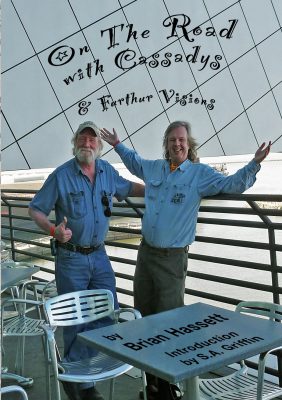
What a disaster! Reminds me the moment I chronicle in the opening of my new book (On The Road with Cassadys) where I pictured massive crowds outside Kerouac’s building in Manhattan on the 50th anniversary of him starting to write the On The Road scroll . . . only to find absolutely No One There when I arrived that night. And now here I am in the blistering cold of an October temperature drop night on the cement of an abandoned post-apocalyptic deserted windswept moonscape in vacant desolate Toronto. Nuthin. Nobody.
I find my friends in the downstairs (not even cool upstairs Library) of the Imperial Pub who have now ordered dinner and the whole night is lost.
But not giving up — there’s gotta be my peeps SOMEwhere in this town on this night at this moment — so about 11:15 I leave my krewe at a table full of red wine and warm food and start power-walking to nearby Nathan Phillips Square where there’s the big lit-up TORONTO sign and where I’ve seen the past 420 protest parties on the evening news . . . but tonight there’s even less people there than when I brought girlfriend Sky & stage partner George to this exact same time last year — and there’s absolutely NOTHING happening — EVEN LESS PEOPLE there! Holy crap! Complete disaster! A handful of tourists, and three teenagers smokin a joint!
Keep burning burning burning calories as I keep power-walking down Queen Street to the Friendly Stranger pot store head shop where I’d read somewhere THAT’s where they were having a countdown party . . . until I get there and the entire street is shut down! But not shut down like a street party — shut down like it’s the middle of the night on a Tuesday, which it is!
I call back to the Imperial dinner krewe. We gotta make the dash to The Mod Club — the only place we’ve found that’s having ANYthing. I want an outside street party — but some party’s better than no party. Tell them to call a Lyft — have Hummer meet me at my car near Massey Hall — it’s 11:27 and we’ve got a major relocation happening!
Power-walk back to the dicy dark Bond Street — car still safe, Hummer nearby — jump in — we gotta get to Little Italy in the West End in minutes. Pull onto Dundas right behind a cop — go to hang a right onto Yonge Street but notice at the last split second a “No Turns” sign — almost got pulled over breaking the law right in a cop’s rearview mirror! Follow him one more block — Bay Street — home of Hugh Reilly’s That Channel who we almost met up with — north to College — hang a left — PattyCake told me the address — 722 College — Hummer looks at the numbers — “172” — “Oh shit” — it’s 22 minutes to midnight by old-school rotary clock in the Blue Bomber’s dashboard — one lane traffic’s a crawl — sprinting through yellow lights, just-turned red lights, any lights, GO! Hummer’s calling out addresses — 224 — 346 — 412 — 16 minutes to midnight — 570 — 642 — 12 minutes to midnight, I’m tapping the clock so we both register how it’s clicking away — then BOOM! around a slight corner and there’s the news crews! Vans & satellite trucks CP24 — CTV — CBC — Global — huge mob clustered at the Mod Club — fly into the packed grocery store parking lot across the street — cop cars patrolling it — find the last spot there is — hop out — no time for smuggling beers — just grab some paper & pen in case brilliance strikes — power-walk through parking lot — some petit pretty babe smiles and says of me to Hummer with a laugh, “He’s gotta get in there before midnight.” 🙂 Cross the street — there’s our friend Lawrence McT being interviewed on camera after telling us he didn’t trust cameras being everywhere capturing our lives like some Big Brother nightmare — but there he is — all 50-something years of him saying to the broadcast cameras of the world that going forward the persecutions of all who have come before will end and from this day forward these unjust laws will no longer imprison the innocent — and we collectively hustle up the wheelchair ramp entrance where the big burley guard says, “Tickets please.”
Wait — what?
No way. “Tickets please. You gotta have a ticket.”
“Wait — I heard this was free.”
“It is. But you have have to have a ticket or an email confirmation.”
“How do we get one of those.”
“You can’t now. That ended two days ago. It’s a free event, but it’s ticketed, and its sold out.”
“But we gotta get in there.”
“Well, you can’t without a ticket.”
Nooooo. PattyCake chimes in, “Who can we talk to?” And he points silently to some doorman with a clipboard.
Up the ramp — “Hi! Hey! How can we get into this thing?”
“You can’t if you aren’t on this list. We’re sold out and the place is packed.”
“But it didn’t say anything about needing a ticket and we came all this way,” as the petit girl from the parking lot whisks past us with her wristband already.
Clipboardman says “No No No,” but PattyCake keeps asking him questions and not moving, the two of us immovably right in his face, until finally . . . “Lemme see what I can do,” and he goes inside, and at least for a moment there’s hope.
Until he comes back out and shakes his head and says, “No, it’s packed, there’s nothing I can do.”
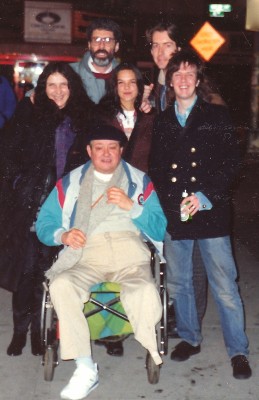
And I tell him we’re all from out of town and we’ve come just to be here. “I’m from New York, she’s from St. Catherines, he’s from Winnipeg . . .” and PattyCake tells me later my face is a dripping candid canvas of disappointment atop my head-to-toe colorful tie-dyed attire thanks to my colorful girlfriend a world away in non-legal America. I ask about people who didn’t show up for their reservations, and PattyCake asks about who else we could ask, until the guy finally says, “Lemme ask my boss,” and goes back inside again. And of course it’s what? One minute to midnight? Already past midnight? Who knows. We’ve missed it. There’s no watch. No time. Looking at the bleak street-front pavement of nothingness Toronto. Cars and idiots and cold and old tumbleweed newspapers blowing through ghost-town streets you want no part of. And the security guys have been trying to kick us off the front stoop the whole time we’ve been there. And one of them comes back out from inside, “No, you can’t come in. You gotta go.” And I’m thinking, the clipboard guy only said he was checking with his boss just to get away from us so security could clear the deck, and it’s mean and it’s cold and the guards are big and the building’s a bank vault with no slippery side doors, and the night’s a disaster.
And then, behind the big mean security guard blockers, the little clipboard man fragilely appears again, meekly behind them, looking at me between big black coats — and then subtly with his one free hand held low, turns it palm up, and motions silently with his fingers towards him to come! BOOM!
Ushered through the door! All five of us! Into the dark packed club . . . just as a giant three-foot Christmas tree of a marijuana bud is lowered from the middle of the ceiling and the band on stage (called Dwayne Gretzky!) is riffin on the powers of the plant and then begin a “Ten, nine, eight . . .” countdown to the Midnight Moment of legalization when explosions of glossy sparkling confetti go off and sprinkle the room in a shimmering shower that we made it inside for by one freakin’ minute!
It may not have been The Golden Goal celebration of the Olympic triumph — but Canada just pulled off something of even greater global impact with this national moment!
This was one small toke for man — but it was one giant puff for mankind.
.
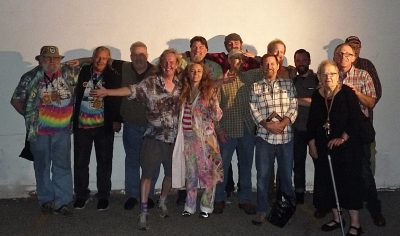
Post show joy —
In the new haze with the CN Tower lit in green behind us 🙂
Friday Sept. 28th 8PM “The Hammer & The Hassett” with Robin “The Hammer” Ludwig the mighty blues master who I’ve done shows with for 20 years from Amsterdam to CBGBs to On The Road‘s birth day — at The Mothership in Woodstock, NY (6 Hillcrest Ave.)
.
.
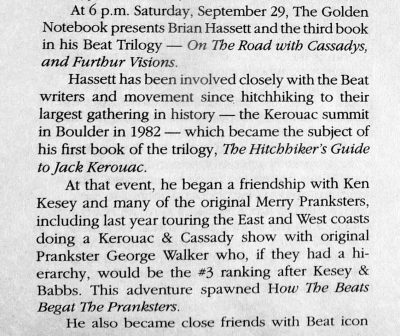
Saturday Sept. 29th 6PM — The Beat Trilogy Comes To Life in a sonic symphony at the coolest bookstore in New York State — The Golden Notebook — 29 Tinker Street in downtown Woodstock, NY — with an afterparty back at the Shivastan Garden (6 Hillcrest Ave.)
.
The following shows are all part of the 30th anniversary ofLowell Celebrates Kerouacin the Beat author’s hometown:
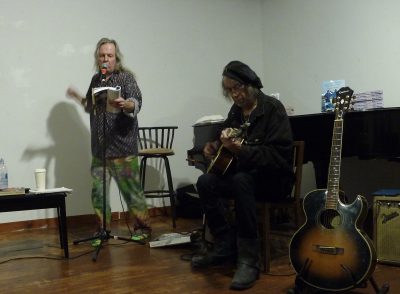
Friday Oct 5th, 7:30PM — The Brian Hassett Roadshow with a three-ring cast of colorful characters — at Zorba’s Music Hall, 438 Market St., Lowell, Mass. (followed by the David Amram Trio’s “Jazz & Jack” show).
.
Saturday Oct 6th, 7:30PM — Cassady & Hassett Bring Cassady & Kerouac To Life — with John Allen Cassady the subject of the most recent book and an on-&-off stage partner of 20 years — at Zorba’s Music Hall, 438 Market St., Lowell, Mass. (followed by Massachusetts’ own Slim Gaillard – Vance Gilbert).
Here’s the show via local Lowell TV . . .
.
Sunday Oct 7th, 1:30PM — The Amram Jam — Hassett with the Amram Trio bringing a little Vincent and a little Jack into the house — at The Old Worthen — 141 Worthen St., Lowell, Mass.
.
.
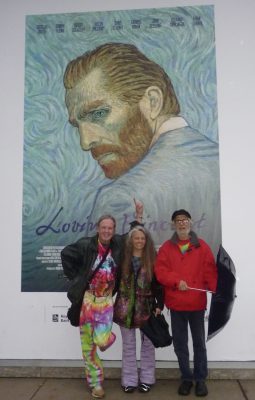
Sunday Oct 7th, 5:30PM — introducing “Loving Vincent” — at the Lowell National Historical Park Visitors Center, 246 Market St., Lowell, Mass.
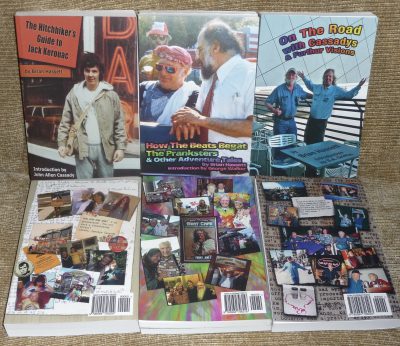
A few years ago, a few people asked me on a Facebook group to tell them about a Kerouac gathering I was at back in 1982, and my response to the question became a book . . . in eleven days, it took.
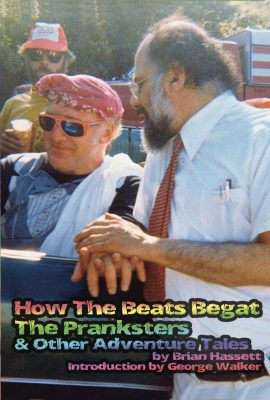
A couple years later, original Merry Prankster George Walker and myself were batting around the idea of how the Beats begat the Pranksters, and it suddenly struck me, “This is a book — Do it as such” . . . and two weeks later we had the book for sale.
This past March, John Allen Cassady & I were talkin about doing some shows together — bringing his dad and Uncle Jack to life on stage — and suddenly it struck me I should write that book he and I joked about writing decades ago . . . and five months later to the day, I was proofing the first copy.
As Kerouac says, “My books are my children.”
And for me, not one of them were planned.
I had three accidents. In a row.
All unexpected. Not a single one had been in my mind the day before the birthing process began. No “Great American Novel” contemplated. No writing workshops or Go Fund Me’s. Just a handful of Go Write Me’s. And Bob’s your Hope — there they were — a stained glass triptych staring me in the face.
“Or no, wait. There’s another word for it. What is it? Trifecta? No. Wait. Trio? No — that’s a musical combo. Triad! Or no — that’s a David Crosby song. What the hell is it? There’s some word for three books. Trilogy! That’s it! Ha!”
Yes, yes — atrilogy! Three connected books that all stand on their own as separate works, or can be experienced as an interconnected whole. Yes! Three books that have characters in common through multiple stories. Yes! Three books that are created around the same time, and especially if in sequence. Yes! Three books that are created with the same motivation, and done in the same style. Yes!
The Hitchhiker’s Guide to the Galaxy! Lord of the Rings! The Nova Trilogy! Oedipus! Snopes! Good company!
As unexpectedly as I stumbled into each of those individual births — I unexpectedly found out I’m the father of triplets! 🙂
Here are a few different print, radio & video interviews and stories and such . . .
.
Here’s a fun rollicking interview from Feb 2026 that kicked off the new “Generation Beat” series where I jam on everything from how it all got started to where it’s all going including how you can still have childlike joy in adulthood . . .
And right around the same time as that ^ Beat interview I was quoted in the oldest Sunday newspaper in the world (from 1791!) about the sale of Kerouac’s On The Road scroll to Zach Bryan — for a new world record price for a literary manuscript — to ensure that it goes to the upcoming Kerouac Center in Lowell . . .
.
And here’s high-energy jam on One Battle After Another and the genius of Paul Thomas Anderson and why he’s a filmmaker in a league of his own . . .
.
Here’s an interview about The Grateful Dead Movie when it was upscaled to 4K and shown in IMAX for the first time ever in August of 2025. Speaking with Lowell Celebrates Kerouac president Mike Flynn, we also go into how Albert Maysles was one of the cameramen, the cameo by Ralph Gleason, the Wall of Sound & all sorts of other stuff — all set to visual enhancements.
.
=============================== .
Here’s the President & CEO of the National Beat Poetry Foundation, Debbie Tosun Kilday, and myself in September 2024 shortly after being presented with their Lifetime Beat Poet Laureate Award. As part of it, I read my Ode To Jack which was included in their 2024 “New Generation Beats” book. .
===============================
Here’s an impromptu July 2023 interview (wearing the Dead & Company Ralph Steadman Sphere shirt) jamming on happiness, creativity, productivity, beating depression, writer’s block, philosophy of life, inspiring others, buoying spirits and so on.
“If we all lift each other up a little bit each day, we’re all gonna get there.”
“The secret formula is *work*.”
.
===============================
Here’s a great conversation as part of a Phil Lesh tribute in November 2024 about he and his band’s legacy and how they kept stretching the music since Jerry Garcia passed.
We riff on happiness and the keys to life, creativity, music, fun, art collectives, kindred spirits, the kindness of strangers, connectivity, empowerment, the counterculture, festival culture . . .
and Kerouac & the Beats, Jerry & the Dead, Kesey & the Pranksters, The Beatles, Taylor Swift, chamber music, ragtime, acid tests, Winnipeg, Manhattan, and all sorts of other people, places and ideas.
===============================
Here’s a fun December 2023 radio interview with the CBC Radio in Winnipeg about the time I wrote a song with Guess Who founder Chad Allan at the age of 15 . . .
Here’s a rollicking interview on WCAP in Lowell about the “Jack on Film: Take 2” show and Jack’s enduring legacy, including nearly 100 photos illuminating the story . . .
===============================
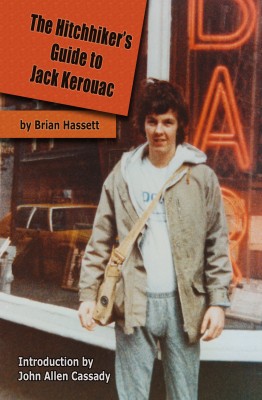
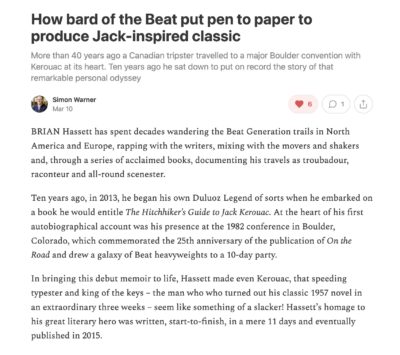
Here’s a wide-ranging jam from March 2023 with British Beat & music writer Simon Warner on the occasion of the 10th anniversary of writing The Hitchhiker’s Guide to Jack Kerouac — including riffing on writing prose as music, the birth of the internet, the eternal nature of art, being an outsider in America, and shining the light, carrying the baton and passing the torch.
===============================
Here’s a lively April 2022 interview by British pop culture chronicler Simon Warner about the connections between the Beat writers and music, and the Beat influences on life itself.
“My whole life’s been a Beat experience. And then I write about it. Real Life Adventure Tales. Five books in five years. That’s Beat personified. I love writing fast and making language sing. I love jazz joints in basements, and jazz cigarettes on rooftops. I love falling in love with a stranger’s stories, and zapping an audience from a stage with electric words. . . . Do as the Beats did – be part of an extended family of like-minded practitioners of magic and shenanigans – and get into good trouble together whenever you can.”
Probably the best interview I ever did was done via video conversation halfway around the world with the Michaelangelian publisher / author / editor David Wills for his special March 2022 “Kerouac at 100” Beatdom book. It runs 20 pages and covers everything from how to write to how to live.
“I have this great analogy – that writing a book is like building a house. The first draft is when you lay the foundation and put up the wooden structure of the whole house – the framework. And then the next draft, you go through and fill in the walls. And then the next time you go through it, you’re putting in the windows. And then on later read-throughs, you’re doing the detail work like painting the windowsills. The whole thing is like a house being built – first you put up the frame. Lots of people make the mistake in writing of obsessing over making the first room perfect without even a roof over their head. This applies to writing anything, short or long. In fact, in the new Beatles: Get Back documentary George Harrison mentions following John’s advice about songwriting – ‘As soon as you start ‘em, finish ‘em.'”
You can order a copy of the book that’s also got a great piece by Gerald Nicosia about Kerouac’s French roots and influence here:
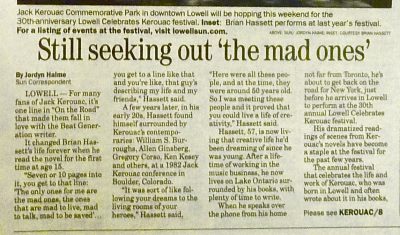
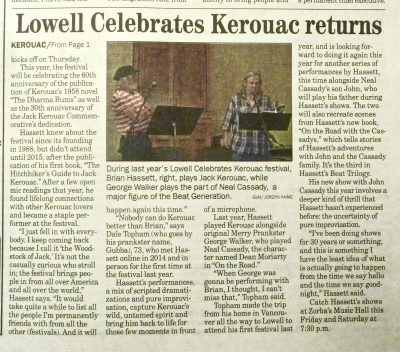
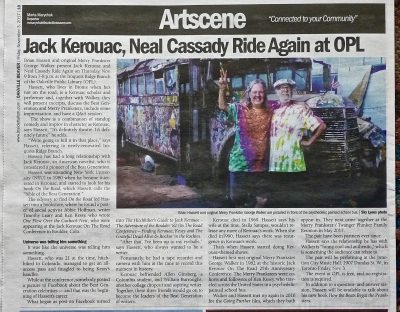
Here’s the front page above-the-fold story in the hometown paper Jack used to write for on occasion, the Lowell Sun, that we were all happily surprised to discover when we pulled into town for the Lowell Celebrates Kerouac festival (Oct. 3rd, 2018).
“Hassett’s performances — a mix of scripted dramatizations and pure improvisation — capture Kerouac’s wild, untamed spirit and bring him back to life.”
.
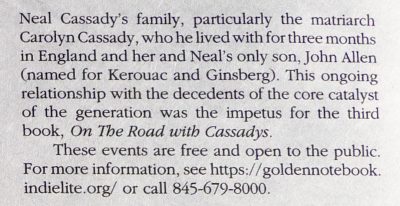
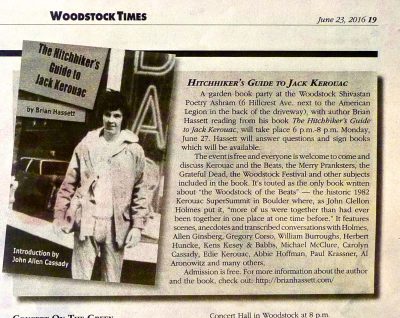
Or here’s what the Woodstock Times had to say of the show & books in the town that spawned the festival . . .
Here’s a Sept. 15th 2018 interview with Mike Flynn at WUML in Lowell about the upcoming LCK (Lowell Celebrates Kerouac) and the meaning of life and tips n tricks for writing and all things Beat & Prankster and such . . .
.
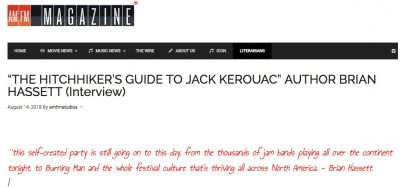
Here’s an August 2018 interview from the very cool AMFM Magazine about how The Hitchhiker’s Guide … got written, plus Kesey & Kerouac & the Pranksters & all that jazz . . .
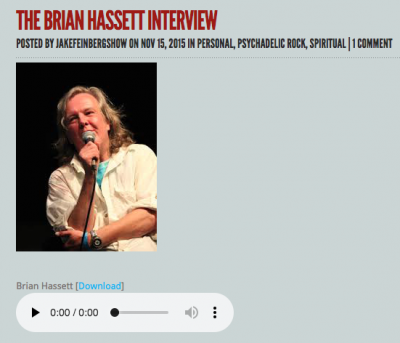
Here’s a really fun lively wide-ranging optimistic laugh-filled radio interview on The Jake Feinberg show in 2015 about the Grateful Dead, Red Rocks, Jack and jazz and the impact of On The Road, the Beats, The Hitchhiker’s Guide to Jack Kerouac, Neal Cassady, Phil Lesh, Bill Graham, Ken Kesey, Neil Young, born leaders, consciousness expansion, love, community, smoking marijuana in the ’40s & ’50s . . . it’s a helluva riff . . . 🙂
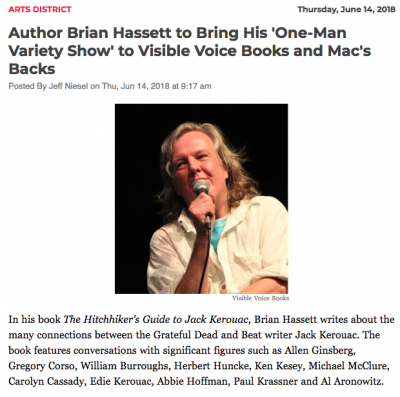
Here’s a 2018 interview for the Cleveland Scene magazine about the writing process, Kerouac’s writing process, the live show process, the Sept. 2018 On The Road With Cassadys book, working with Bill Graham and all sorts of other stuff . . .
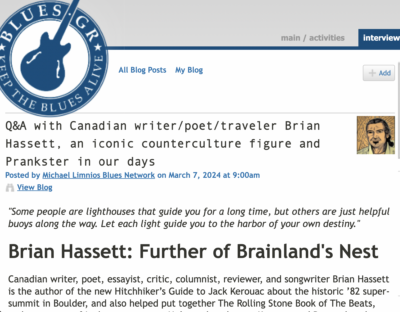
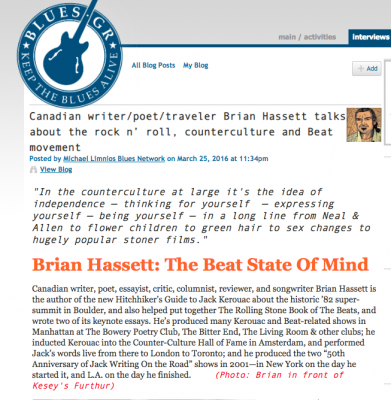
Here’s a print interview with Michael Limnios at the great Blues – Greece magazine & website about the most important life lessons & advice, life-changing moments, the meaning of ‘Beat,’ its impact on culture, its connection to rock n roll, and lots more . . .
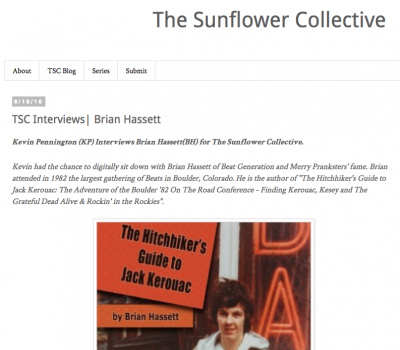
Here’s the Kevin Pennington interview for The Sunflower Collective about the mindset behind On The Road and the Beat Generation, and how it manifests today, and the Merry Pranksters and the Acid Tests, and the Beat Museum’s big Beat Shindig and a whole lot more . . .
Here’s a piece about George & my tour in The Oakville Beaver in Canada . . .
.
Or here’s this from the Woodstock Times when I first appeared there with the first book . . .
.
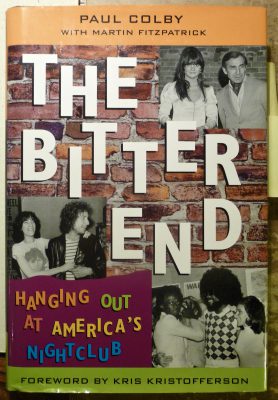
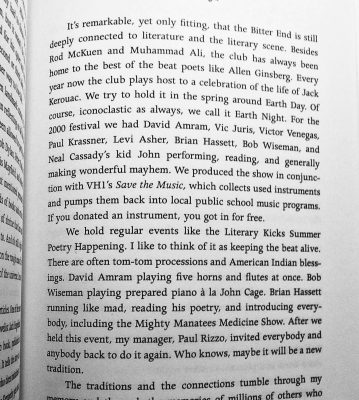
Here’s where the founding owner of the historic Bitter End club on Bleecker Street in Greenwich Village New York City wrote about me and my shows in his autobiography . . .
.
Here’s where I interview Beat legend Gerd Stern at The Beat Museum’s Shindig in San Francisco in 2015 about the Joan Anderson letter that He Did Not Lose, and Allen Ginsberg & Jack Kerouac & Neal Cassady, and the whole San Francisco scene back in the ’50s and ’60s, and his pioneering multimedia art . . . . . .
Here’s the lively & funny Cassady panel discussion at The Beat Museum’s big Beat Shindig in 2015 with Al Hinkle, Jami Cassady, & myself, moderated by Levi Asher (now Marc Stein) . . .
Here’s a funny wild crazy Adventure Tale video interview response for filmmaker Noemie Sornet’s On The Road film project . . .
here’s part 2 —
Here’s the August 2009 Kelvin / Winnipeg Reunion Breakfast Television show on CITY-TV with Linda Ranson in Winnipeg . . .
.
And here’s Shaw TV’s segment from the same event when they showed up at the tour of Kelvin — and I forgot they were coming!
About keeping friends: “Foster them, water the plants, enjoy the flowers, and tend to your garden of friends, because that’s where you’re going to be living the rest of your life. They’re gonna be with you, and you with them.”
.
More’ll be added as I do them or find them in the archives or get around to converting the old TV interviews on VHS tapes and radio riffs on cassette. 😉
We’ve had a flood of famous & important people dying the last few years. 2016 was the recent one most think of as the mass kill-off year that had us all praying for it to end — which it did, sadly, in November, with democracy and decency being cremated before our eyes.
The last famous person’s death that really threw me — well, it was two in 2014 — Philip Seymour Hoffman and Robin Williams, both completely unexpected, and both inspirational teachers in my life.
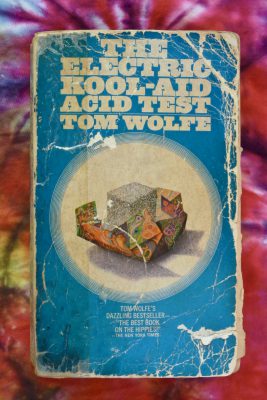
But Tom Wolfe’s passing on May 14th brought me to unexpected tears several times that day. And it was really because of one work — The Electric Kool-Aid Acid Test.
That book changed my life as much or more than any other. When I first read it at age 15 it blew open what was possible to this comfortable kid in Mayberry, Manitoba. Acid Tests . . . the Grateful Dead . . . road trips in a bus . . . a new way of talking . . . a new way thinking . . . a new way of being. A Prankster! Playful & goofing, but productive & curious. These weren’t people sitting around waiting to be entertained — everything about them was proactive, about doing, about making things happen. And being funny! I wanted to be one of them — and I became one of them by my own actions, in consort with others. That book changed my approach on how to live, how to interact with others, how to be part of a collective, and I carried it with me into high-end concert production & low-level club shows, into life in a giant corporation & life within a tiny community.
As the years rolled on, I read a lot of other books — including Kerouac, who Wolfe in part hipped me to by writing about this Neal Cassady guy on the bus — and I began writing more and more seriously as the years went on. I was influenced by Dr. Seuss and William Shakespeare, James Joyce and Hunter Thompson, Dave Barry and Eugene O’Neill, the Beats and the rock poets. But as my writing and life evolved, I read less of the playwrights of my formative 20s, only occasionally dipped back into Dr. Seuss’s playful mastery, and retained the lessons of Joyce without rereading him too often. But the one prose canvas, more than On The Road or Huckleberry Finn or Fear & Loathing that I kept returning to with jaw-dropped awe was Electric Kool-Aid Acid Test.
As Kerouac wrote in a piece for the Writer’s Digest titled “Are Writers Made or Born?” — “It ain’t whatcha write, it’s the way atcha write it.” And Tom Wolfe applied that playfulness to his playful subject, so perfectly reflecting in prose the scatological waves the Pranksters thought and operated. It’s the greatest, most effective long-form blend of prose and subject I’ve ever come across.
Kesey said to me in a “you gotta hand it to the guy” way, and also thankfully put it on the record in this 1989 interview with NPR — “Wolfe’s a genius. He did a lot of that stuff, he was only around three weeks. He picked up that amount of dialogue and verisimilitude without a tape recorder, without taking notes to any extent. He just watches very carefully and remembers.”
Looking back on the oeuvres of literary masters of the 20th century, Wolfe joined a pretty esteemed group that included Jack Kerouac, John Clellon Holmes, Allen Ginsberg and Ken Kesey who wrote about that singular inspiration Neal Cassady — “smiling and rolling his shoulders this way and that and jerking his hands out to this side and the other side as if there’s a different drummer somewhere, different drummer, you understand …. “
When I was writing The Hitchhiker’s Guide to Jack Kerouac, every night that I went to bed still having the mind strength to read, it was Electric Kool-Aid that I’d open the pages of. Not On The Road or Fear & Loathing, but rather the guy who stretched language even Furthur, who left me in awe with the rules he would break paragraph after paragraph, while still maintaining a clear, gripping, fact-rich narrative. He was moving James Joyce up to the 1960s; he was breaking more rules than The Subterraneans; he was simultaneously being Pollock and Rembrandt.
Some people over the decades disparaged Wolfe, and Electric Kool-Aid in particular, and I think that caused me to not speak up for the book as much as I should have. But when he died, I realized how that one work changed my life. Twice. First in its subject matter . . . and years later in the mastery of its prose. And what brought me to tears was that I never told him that. Or anyone, really. I met and spent time with most of the authors I admired who were alive when I was. Except Wolfe — even though we lived in the same city for a quarter century.
I regret not thanking him for changing my life. I regret not defending his writing. I regret not standing up for him, and not celebrating his book. I regret letting other people silence me, or make me think I must be wrong in my take on that book.
With Wolfe’s passing, and my uncontrollable tears that day, I learned the tough lesson to never again be silenced by anyone else’s opinion of a work of art — especially writing!
I need to get in touch with Kinky Friedman and Aaron Sorkin and Matt Taibbi before its too late!
Love your inspirations. And don’t let anybody tell you otherwise. And if you can tell the creators while they’re still alive — do it. Thoughts & prayers & platitudes aren’t going to cut it for you or them after it’s too late.
.
(my original copy, bought at The Bay in Winnipeg in 1976)
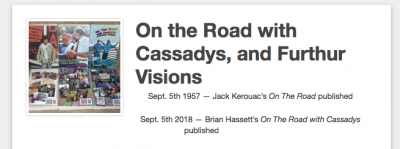
An excerpt from my upcoming book (Sept. 2018) — On The Road With Cassadys & Furthur Visions —
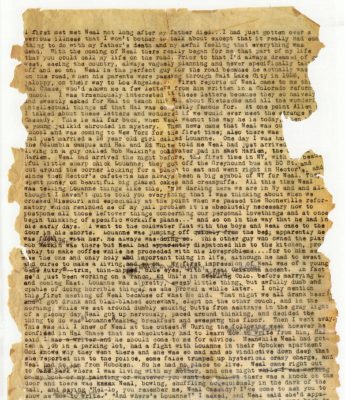
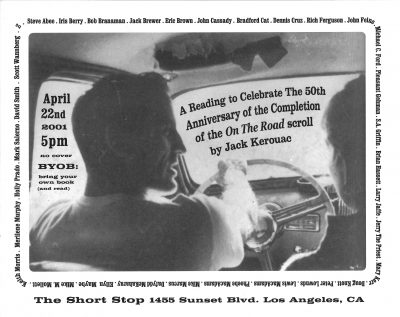
This bit is about 2001’s 50th anniversary of Kerouac writing his On The Road scroll — and a show we put on for the occasion in L.A. on the day he finished it, April 22nd, after one held in NYC on the day he started it (also covered in the book).
.
I arrived at the Short Stop speakeasy well before showtime and it was already a chaotic circus of crazy creatives carving up the scenery, led by the director of today’s movie, S.A. Griffin.
Amazingly, he’d had a shirt made emblazoned with the classic OTR line about “… the mad ones … DESIROUS of Everything AT THE SAME TIME …” written in creative font-smashing text covering his chest — broadcasting its meaningful message in a playful style, perfectly reflecting his prankster essence.
The club was already a buzzing hive full of L.A. actors and poets and show people decorating the large performance space with bodies and actions — a room that looked like a fancy Goodfellas’ lounge from the ’50s or ’60s with almost no lighting so the celebrities and gangsters and cops could discreetly entertain in deep red booths surrounding the open dance floor in the middle — the only lighting being flickering candles in large red-tinted translucent holders on every table as well as lining the perimeter of the stage.
In the middle of the dance floor lay a giant 3-foot-by-4-foot photo of the first part of The Scroll — and scattered all around it like fallen leafs were page leafs of On The Road that throughout the celebration people would pick up any random one and read it from the stage, a la Burroughs’ cut-up method, except whole pages to collage the poetry of the prose into a swirl of images and passages and dialog and details jumbled together proving how powerful and consistent the wordsmithing was that you could hear chapter 1 or 51 and it would still fit together like a matching set.
S.A. created something I’ve never experienced at any Jack show before or since — a massive mad celebratory krewe of joyous orgasmicly LOUD participatory audience–stage–melding dancing dingledodies — AND I mean, LOUD! It was MAD high energy at 6PM on a Sunday like it was a midnight on Saturday night at Mardi Gras.
The room became more than packed. The pages on the dance floor were soon blown up to the lip of the stage as it filled with men & women floor-dancing in floor-sitting crosslegged positions, and the doorways crammed with faces peering in.
And like the rock star he was, Cassady came strolling in just before showtime with his latest babe on his arm and perpetual smile on his face. He was laughing and she was beaming and the party was screaming and I felt like I was dreaming.
From the moment S.A. stepped to the microphone to open it — and he’s one guy who doesn’t even need a microphone to fill a room with his booming performer’s voice — the souls he’d assembled soared and roared like an arena rock show.
I kicked it off with the beginning of the original Scroll text that I’d transcribed from the two photographs of it that had been published by 2001, and right from the first line people were Howling “Go!” and “Yeah!” and “Wow!” and laughing and cheering. And the next readers began improvising off-script and working the room, the audience riffling in lines in harmony with Jack’s in a collective kaleidoscopic recreation of the creation of the Beats. As loud and orgasmic as new life comes! with beaming faces and embracing hugs and love and sweat and knowing twinkles between bubbling souls.
There were no rehearsals, no memorized scripts, just the chaos of people running to the microphone with parts of the Scroll or part of the Book in what S.A. coined “Bop Bingo!” And people were yelling “Go Go Go!” from the swirling booths, and S.A. copping “the mad ones” line in this mad hang-out as it blazed from his chest in case anyone missed the obvious.
Then one of his crazy Carma Bums co-conspirators, Scott Wannberg, stepped up to speed-read Jack at the tempo he probably typed, causing even faster “Go”s from all over the room.
Then Michael C. Ford drove into the spotlight all high-energy — the Grammy-nominated spoken-word artist who performed with Jim Morrison back in the L.A. day, and recorded with all the other Doors since — he took the wild Slim Gaillard club show part of On The Road out for a playful right-orooni ride, getting all Putti-Putti all-rooti, as the audience started laughing-orooni with all the be-bop-orooni a-la-vooni shim-sham jimmy-jam thank-you-man howdy-doody, all-rooti! The room was howling and the stage raging and spirits dancing and Jack’s typewriter clacking a thousand miles an hour as the high-powered Ford fired on all cylinders to crack the code and break the barrier and spike the sound and remind us all that — “To Slim Gaillard the whole world was just one big orooni!”
Then John and I took the stage, the Bebop Brothers flip the page, bringing back the driving sage, pinning needles on the gauge.
Johnny riffed on how his Dad was just a big grown up kid, and how he’d come home and be fun and funny as hell, often bringing strange gifts, like a little hollow wooden pig he brought back from Mexico that if you put a live fly inside it, would actually cause it to walk across the table. (!)
And how he loved his Dad, and even if other people claimed Neal was off having Adventures with them, it felt to John like his Dad was home all the time. And how his Mom had to be the disciplinarian, and how he grew up with a fairly idyllic childhood — one parent providing the roof over head and meals on the table, and the other being a big playmate.
And we traded off On The Road readings, John partial to the jazz joint riffs, punctuating them with personalized details and comedic asides. “Everybody was rocking and roaring. Galatea and Marie with beer in hands were standing on their chairs, shaking and jumping.” — “What a party! Where was I?!”
And every time Jack would quote his Dad yelling, “Whoo!” or “Go!” to the jazz, the audience would yell it back to John creating a call-and-response song out of a prose-and-participate book.
And sitting right in the front was a gorgeous cross-legged L.A. woman dancing from the waist up, arms flowing in hypnotic figure-eights, fingers snapping … then exploding like slow-motion fireworks, all in an above-waist interpretive dance — part sign language, part snake-charming seduction.
And Sugar Magnolia, as I took to calling Aurora, was half the time on the side of the stage, half the time against a wall in the light in our joyous view, and half the time at one of the tables taking notes.
And John & I hit The Road together — reading the Jack & Neal car-riding “IT” section from On The Road that George Walker & I would later appropriate and open every one of our 20 shows together 20 years later, but this was the first time either John or I ever duetted it, and he had the Neal rhythms down. Naturally.
“… everybody knows it’s not the tune that counts — but IT!”
And speaking of tunes, the most musical of all the Cassadys, Johnny C. Goode, broke out his electric guitar and filled in the colors as I read the part of On The Road after his Dad dropped off Uncle Jack in the California sister city of San Francisco and he started to have hunger-induced hallucinations. “I had reached the point of ecstasy that I always wanted to reach, which was the complete step across chronological time into timeless shadows, and wonderment in the bleakness of the mortal realm …” as Johnny accented the “wonderment” with his crystalline lines.
And with the Ken Burns’ Jazz series having just aired on PBS, we thought we’d offer up Jack’s own history of jazz in one of the OTR riffs that Kerouac’s principal musical collaborator David Amram remembered as one of Jack’s favorites that he liked to read aloud — the “children of the American bop night” paragraph that begins, “Once there was Louis Armstrong blowing his beautiful top in the muds of New Orleans …” where he lays out the whole evolutionary tale in one page that Ken Burns took 20 hours to tell.
And Johnny picked up on the Johnny B. Goode echoes when Jack wrote of “Charlie Parker, a kid in his mother’s woodshed in Kansas City, blowing his taped-up alto among the logs, practicing on rainy days” and how that was captured so similarly by Maestro Chuck — “Way back up in the woods by the evergreens, There stood a log cabin made of earth and wood . . . He used to carry his guitar in a gunny sack, Go sit beneath the tree by the railroad track,” as John melted Bird and Berry into a single rockin Bebop-a-Lula, and oh boy that little country boy could play!
Ragtime became Swing became Big Band became Bop became Rock n Roll became the Acid Tests became Woodstock became a million bands that burned burned burned like fabulous roman candles across the land.
Then John & I took a trip “to see George Shearing at Birdland in the midst of the long, mad weekend,” as Jack opened another of his favorite On The Road passages that he read to Amram’s backup back in the day, now with a Cassady in on the tune, and Johnny warmed up, effortlessly pealing off riffs, “slowly at first, then the beat went up, and he began rocking fast, his left foot jumped up with every beat … his combed hair dissolved and he began to sweat!”
The audience was now howling like a collective mad Moriarty yelling for us to “GO!!” as Cassady soared and the audience roared with every new chord that felt like a sword pulled from a stone! Excalibur!
“There he is! That’s him! Oh God, Oh God, Cassady, Yes! Yes! Yes!” And Johnny was conscious of the madmen in front of him, he could hear every one of their gasps and imprecations!
Their essence was born of the road and adventures. They worked in improvisational music like spontaneous prose.
They broke every rule of showbiz … then broke every concert record there is — just as Kerouac broke every rule of grammar — then had over 50 books in print.
Like Jack . . . . the band had a prolific career whose output spanned multiple genres and decades, had many different co-conspirators, and found inspiration in the mythical characters of the West and the open Road. And they both considered Neal Cassady their driving force — in fact he literally drove each of them On The Road.
Both the Beats & the band had a core member who drank himself to an early grave, and others who spent considerable time & effort exploring the benefits of psychotropic drugs. Both groups were largely based out of San Francisco, and both had New York as their other home. And in fact, it was the very same neighborhoods of both cities — North Beach and Greenwich Village — where each came of age before growing out into the rest of the city and world.
San Francisco has a centuries-old history of radicals, rebellion and reinvention. From Jack London to John Muir, Haight-Ashbury to Silicon Valley, the Bay Area has nurtured iconoclasts and outcasts, fostering new paradigms since its founding, be they environmental or cyber, free love or free jazz, gay rights or immigrant’s plights.
Hence, when Carolyn Robinson first moved to the city and planted the flag that would beckon her future husband Neal Cassady years before Lawrence Ferlinghetti or any other Beats ever set foot in the place, it was a town that already personified everything the burgeoning movement was about.
It was an outsiders’ oasis, a North American version of a European masterpiece of architecture to inspire every walking breath, a multi-hilled town of innumerable little villages, each with a thousand stories pouring out of every 3-story Victorian house.
And Jack fell in love — not only with Carolyn and his life-brother Neal — and so much so that he actually moved there briefly with his mother in 1957 — but also with the mirror city spirit of his beloved New York — the jazz clubs, the neighborhood bars, the openness and effervescent ever-changing characters and concepts that sprung from every 5-cent coffee or 10-cent beer.
And just as the Beats’ work brought this open-minded life-embracing sense of Adventure to the rest of the world — so too did the music that manifested there in the mid-’60s.
Bob Dylan may have gone electric on the East Coast, but the real electricity of the kool-aid of cool rock n roll came from the West, young man.
The Dead were proud flag-waving Beats who were keeping the beat in a whole new way.
Just as Jack took a novel approach to novel construction, the Dead did the same with song structure. Just as Jack soloed on the keys stretching his flow and ideas to places heretofore unseen, so did that other “J” — Jerry — play his lines into a whole new space unheard in music save for the best of Jack’s beloved Be-Bop.
The Dead were not only the natural progression of the music of the Beats — but also of the very city that was home to both. In fact, Jack was so comfortable with each, he easily recast The Subterraneans events from New York to San Francisco in just three days of storytelling.
* * *
Unlike most bands and authors, both the Grateful Dead and Kerouac’s popularity only grew after their primary heartbeat stopped — with the Dead’s 2015 Fare Thee Well shows in Chicago breaking TicketMaster, pay-per-view, and Soldier Field all-time records — and Kerouac having roughly four times as many books in print today as he did the day he died. Not to mention the thousands of Dead-based bands playing around the world as you’re reading this, . . . or the hundreds of copies of On The Road that will be bought somewhere every day that you have this book in your hands.
Yet they both had inauspicious professional debuts (the Dead’s first album and Jack’s The Town and The City) — which, in most cases, would have presaged an undistinguished career — and certainly not be indicative of an artist who would end up changing their medium and worldwide culture.
And both had an unusually strong affinity for the other’s form. Garcia was a voracious reader of books, and few novelists lived a life with as strong a connection to music as Jack. And the Grateful Dead were the only band that either Jack or Neal ever sat in with.
Really it was — as it always seems to be — Neal Cassady at the center of the whole damn thing. No other rock band can claim anywhere near as close a connection to any one of the key Beats as the Grateful Dead can with their brother Neal. He lived at their house, ate at their table, drove their bus, performed on stage with them, and directly inspired some of their most oft-performed songs — including ‘The Other One‘ and ‘Cassidy.’ Not to mention that ‘Truckin” is a musical On The Road, or ‘Wharf Rat’ is their Big Sur, or ‘Attics of My Life’ their Book of Dreams, or that ‘Mexicali Blues’ echoes Mexico City Blues, or ‘China Cat Sunflower’ could have been lifted from Old Angel Midnight, and on and on.
But Cassady . . . Cassady . . . Cassady . . . the guy Jack most wanted to impress, ditto Allen — the Mighty Muse — and just as with them, he was there from the beginning with the Dead — on the bill or on the stage at many of the original Acid Tests including their now-legendary first big-venue gig — The Trips Festival — at the Longshoreman’s Hall in good ol’ S.F. in January ’66.
= = = = = = = = = = = = = = = = = = = = =
Then this goes on for many pages including lots of quotes by Garcia, Robert Hunter, John Perry Barlow, Phil Lesh, Bob Weir, Bill Kreutzmann, Rock Scully, Dennis McNally & many others.
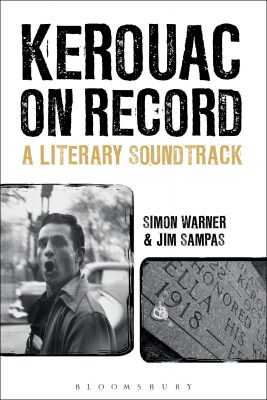
You can order the book here that also includes pieces the great Holly George-Warren, the British Beat scholar Simon Warner, film & record producer Jim Sampas, the British jazz scholar Jim Burns, the On The Road manuscript specialist Matt Theado, the longtime American music scholar Pat Thomas, and many many more.
Just as when Gifford & Lee created Jack’s Book in the ’70s, and Allen Ginsberg did the Jack Summit in 1982 and all those documentaries were made — it was all because there were people alive who knew Jack well.
Now there are very few.
Here’s a list of Living People who either met Jack Kerouac or knew him well . . .
(to be added to and modified as we go)
David Amram – composer & jazz bandleader
Cliff Anderson – author and Jack’s friend in St. Petersburg
Nikita Angelakos – Lowell resident
GJ Apostolakos – Lowell resident
Ken Babbs – original Bus-riding Merry Prankster – Intrepid Traveler – author
Tommy Belkakis – Lowell resident
Ron Bevirt – original Bus-riding Prankster photographer
Paul Blake Jr. – son of Jack’s sister Nin
Helen Bone – knew Jack in Rocky Mount, NC
Gary Boyle – Lowell resident
Bonnie Bremser – author and wife of Ray Bremser
Nancy Bump – Lowell resident
Cappy’s Copper Kettle owner – bar owner in Lowell
Caleb Carr – son of Lucien Carr
Ethan Carr – son of Lucien Carr
Francesca “Cessa” Von Hartz Carr – wife of Lucien Carr
Simon Carr – son of Lucien Carr
Cathy Cassady – daughter of Neal & Carolyn Cassady
Jami Cassady – daughter of Neal & Carolyn Cassady
John Allen Cassady – son of Neal & Carolyn Cassady
Phil Chaput – Lowell resident
Ann Charters – biographer
Anthony Countey – Northport neighbor, band manager, event producer
Ten years ago this month BrianHassett.com was launched.
I’ve published at least one new story every month since it was birthed — except once! when I unexpectedly fell in love & went on tour in the same month (June of last year). 🙂
One thing about writing — you never know what’s gonna connect with people. Jerry Seinfeld recounted this very subject from his last conversation with George Carlin — how neither of them ever really knew what was going to work until they put it in front of an audience.
Over the decade, a bit to my surprise, the five most popular stories on the site have been, in order —
The most popular piece just started as a list of a few names created after someone I knew said to childless me something like, “People who don’t have children have no value.” . . .
Oh yeah?
I’ve periodically returned to it over the years — like when a famous person’s obit mentions they had no kids — and it’s gradually grown to nearly 350 people you mighta heard of from philosophers to rock stars.
It’s now linked all over the internet, and I think it’s the top result if you Google the subject. There hasn’t been a day glo by in years that a bunch of people haven’t read it.
Funny thing is — it started out as a response to one person’s one comment — and now tens of thousands have read it! 🙂
.
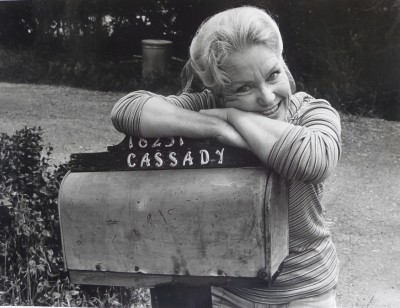
The Carolyn Cassady Tribute caused me to be contacted by the New York Times, the L.A. Times and all sorts of people. It was the first announcement on the interwebs that she had passed.
Her son John was living with her, thank goodness, when she fell ill on a Sunday night, and by Friday she was gone. John was sending out daily emails to about a half-dozen family members, of which I was gratefully considered one after spending so much time with both Carolyn and John. I guesstimated that her kids would be too caught up in what was happening to also be writing a tribute to her. And I loved that woman — despite us having our differences like any two people who love each other do. So, during that week, as the news was not improving, I started a tribute to her just in case, and thus was able to post it within an hour or two of receiving John’s final fateful email that Friday.
Levi Asher published it on his LitKicks website, and told me it’s also one of the top five most-read stories on his site.
.
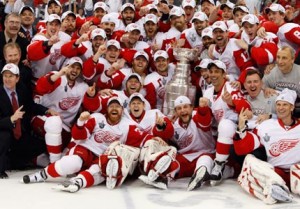
The Detroit Red Wings 2008 playoff lineup page — I have no idea what’s behind this post’s popularity. I mean, they were a GREAT team and all, and it’s a really well done detailed roster by position and everything, but jeez, I dunno why people keep coming to it. But they do. I think this story about sneaking on the Penguins’ bus is a much more fun hockey piece. 🙂
.
The Henri Cru story’s popularity also blows my mind. I mean — how many people know who Henri Cru is? Well, apparently a lot. 🙂
Henri was a good friend of Jack Kerouac’s, and then became a good friend of mine — another of Jack’s old pals, like Carolyn and Frankie Edie Kerouac Parker, who I came to really love. As I say in The Hitchhiker’s Guide to Jack Kerouac describing Jack’s other friends I met at the historic Boulder ’82 On The Road summit — “There was this constant commonality among most of the people in ol’ JK’s life. Odd ducks. As a novelist, Jack magnetized to these people as fodder for his fiction.”
I first met Henri through Edie, who had been Henri’s girlfriend until he made the mistake of introducing her to Jack. 🙂
You know that TV show Hoarders? Well, way before we got to look inside those people’s homes and learn about the disease, there was Henri Cru. This was probably 1983 or ’84, and Edie and I had become friends, and she told me about Henri and how he was cleaning out his apartment at 116 MacDougal Street up above the Kettle of Fish and the old Gaslight Café. When I got there to help the first time, I met a guy out front who told me, “When we get upstairs, just remember, we’ve been hauling stuff out of there for three weekends now.”
When we got up to the fourth floor of the walk-up and opened the door, that was about all you could do. It was literally floor-to-ceiling stuff. One person (me) would climb up on top of it into a little maybe 18-inch high crawl space along the ceiling (!) and would pass stuff out to a waiting person back in the doorway as we hacked our way down through the glacier. It was like an archeological dig — including cuz we were looking for treasures, which he did have in there (like an unpublished manuscript by he and Kerouac, and a case of unopened Jack Daniels bottles from about 1963). I remember digging and digging, until we would uncover the top of a door frame. “Hey! I just found another room!”
Henri had recently lost half a leg to diabetes and had to move to a building with an elevator, which, when he first moved in, was as pristine and empty as any new apartment would be. By the time he died a few years later, it had come to look like MacDougal Street, but with a maze of poles crisscrossing the room like a spider web that he could hang stuff from.
At some point in the journey, Henri was turning 70, and wanted to do sumpthin special, and asked me to write a story about the night for him as a birthday present. I did this, and somehow it survived all the years since, and there must have been a digi copy that didn’t get lost in all the various crashes and program updates and obsolescence that plagued the early computer years, and back in 2010 I republished it (after it ran in a couple different Kerouac/Beat magazines).
“Feature my surprise” (as Henri would say) — of the 200+ stories on the site, that his birthday night would be the 4th most-read of all-time!
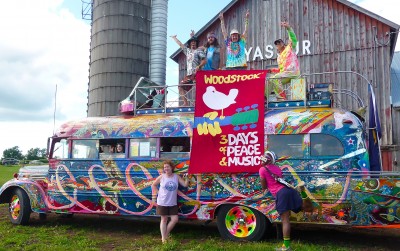
Plus, I like that it both captures an historic moment with Kesey’s Bus returning to Yasgur’s Farm for the first time since 1969, but also that it set in motion a series of events and friendships whose storylines are still being written.
I realize that visually it’s an old format, but ya’know? I hate it when websites change. You learn how one works . . . and then they change it. Well, my site’s been functioning the same way for 10 years now 🙂 just with a few more categories and a shit-ton more material. What the heck.
For all those who’ve been here before — I hope you’ve enjoyed the ride!