
Musicians’ Movie Masterpiece — ‘Round Midnight movie breakdown, background & review
.

Jazz sparks the synapses and lifts the spirits — and ‘Round Midnight lives up to its genre. I can barely get through any 15 minutes of this film without it firing me off into unexplored stratospheres of beauty, tingling with goosebump awe.
There’s the music of the script’s dialog … the music cookin’ by the A-list jazz musicians … the story of an innocent appreciator connecting with a master … the setting of Paris jazz clubs in 1959 … alcoholism and drug addiction lingering like a hanger-on that won’t leave … the process of creation never shutting off for those gifted with it and afflicted by it … all of it is soaring through every minute of this sonic cinematic masterpiece.
While this is probably the greatest film ever made about music & musicians – it’s also a movie about friendship and love — the love among collaborators who share a collective creation, in this case a band making music on a stage in a club — the love of an artist for his or her craft — the love of a devotee for the work of a genius — the love between a father and daughter — the love between old friends and old flames — the love that transcends ages and cultures — the love of life … and art … and beauty.
Based on the true story of Parisian jazz enthusiast Francis Paudras who befriended and cared for aging bebop pioneer Bud Powell, shepherding him back to health and back to New York. It also blends in saxophonist Lester Young’s life story, all manifested thru real-life saxophone master Dexter Gordon, who actually recorded with Bud. But it’s also the story of all Black jazz expatriates who left the rank racism of 1950s America and relocated to Paris, including Lester, Thelonious, Sidney Bechet, Josephine Baker, Kenny Clarke (the bebop drummer), and also unappreciated white cats like Bill Evans & Chet Baker who followed them, many of whom were also in the real Francis’s orbit.

Wildly, Francis wrote an autobiographical biography of jazz giant Bud Powell, much like another bilingual French-English bebop-enthusiast writer named Jack Kerouac who wrote autobiographically about his life among artistic giants and bebop music. And in another crazy twist, the actor who plays Francis bears a striking resemblance to Kerouac in those jazzy ’50s years.

photo courtesy of Yuko Dalachinsky
The great socially conscious award-winning French director Bertrand Tavernier took up the project in the 1980s, co-writing the screenplay based on Paudras’ memoir, and enlisting Hollywood producer Irwin Winkler who championed stories of heroic underdogs going up against seemingly insurmountable odds like Rocky and The Right Stuff.
It was Tavernier who insisted on casting the real jazzman Dexter Gordon, who had never acted before, and was in the twilight of his career – dying at age 67 less than four years after the movie came out.
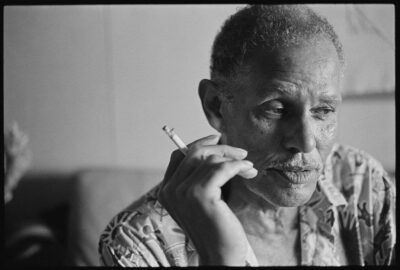
His performance is so outstanding he was nominated for an Academy Award for Best Actor in a Leading Role, the first & only jazz musician ever so honored.
And Tavernier continued his authentic jazz casting, bringing in a young-looking 45-yr-old Herbie Hancock to lead the on-screen band and compose, arrange & conduct the score — which led to him winning the Oscar for Best Original Score, the only time he ever appeared on that stage.
A movie about music and musicians . . . and the music comes first
Tavernier wanted all the music to be played & recorded live on camera, so they brought in a who’s-who of jazz masters who could lay down perfect takes every time, including John McLaughlin, Wayne Shorter, Ron Carter, Tony Williams & Freddie Hubbard among others. Herbie also plays the bandleader in the movie, and renown vibraphonist Bobby Hutcherson plays a confidant to the Dexter character, appropriate since the two were actually friends since childhood. Plus, unlike pretty much every other dramatic film about music, the songs here are complete (or nearly complete) and not the 60-second versions we’re teased with in other films.
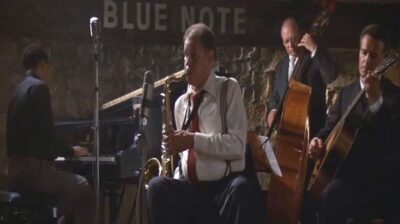
Herbie Hancock, Dexter Gordon, Pierre Michelot, John McLaughlin
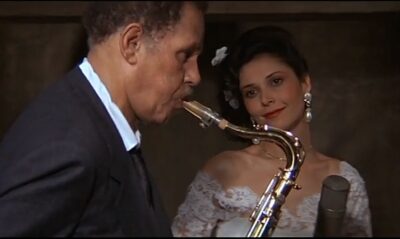
The other musical casting gem is the sonically soulful Lonette McKee who delivers one of the most divine duets ever captured on film sharing voice and sax with Dexter on the Gershwins’ How Long Has This Been Going On?
The non-musical roles are also perfectly cast, including the heart-on-his-sleeve jazz pupil, co-lead Francis played by the in-demand French character actor François Cluzet, who, again, has a striking resemblance to the Franco-American jazz disciple Jack Kerouac.
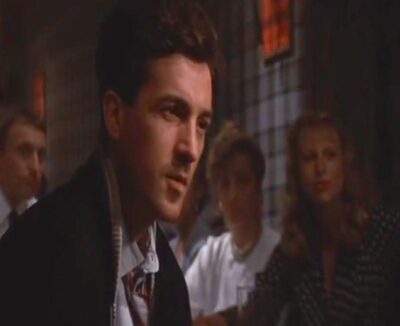
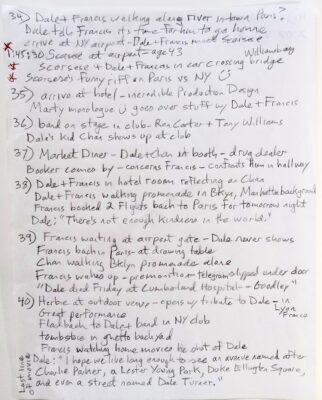
As if this mind-blowing A-list cast isn’t enough, the film has a comedic ace up its sleeve that’s not revealed until an hour & 45 into the movie when we’re surprised by the comically fast-talking New York impresario played as only he could by no less than Martin Scorsese.
By 1985, producer Winkler had shepherded Marty’s Raging Bull and New York, New York thru production, and surely the busy director would never have set aside the time to play this role if not for his love & respect for Winkler — who would later go on to produce Marty’s Goodfellas, The Wolf of Wall Street, The Irishman & others.
To me, this movie is the miracle Alejandro Iñárritu was talking about when he famously said — “To make a film is easy. To make a good film is war. To make a great film is a miracle.”
No other filmmaker had ever picked up on this real-life story of a jazz fan and a jazz master connecting. And it all happened in France, so a North American director would never have had the same sensibilities or brought the same authenticity that a local arts connoisseur would imbue the project with.
And there is no other capture in a non-documentary film that I’ve ever seen or heard of like Dexter Gordon’s here. This is a genuine jazz genius being his eccentric self in front of a camera. There are so few of these humans ever born. That one has been captured in a masterpiece of a dramatic film puts this movie in a class of its own.
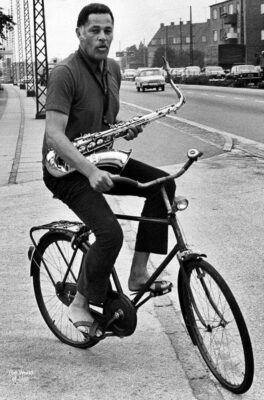
Dexter in Copenhagen during his 10-year exile
Then add to that an absolutely great dramatic script with so many fully fleshed out & fun characters … the exciting puts-you-there cinematography … the quick cool jazzy editing … the realistic production design of down-&-out Paris & New York circa 1959 … and the phenomenal sound editing and live recording of both the music and Dexter’s soft non-theatrical vocal projection. They had to capture him live because he’d never be able to loop this chit.
Musical highlights to savor
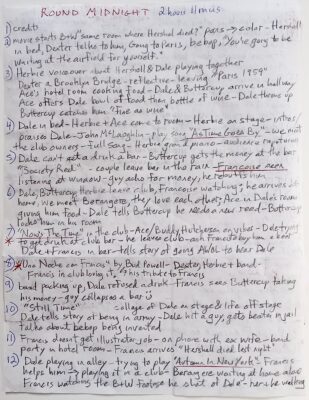
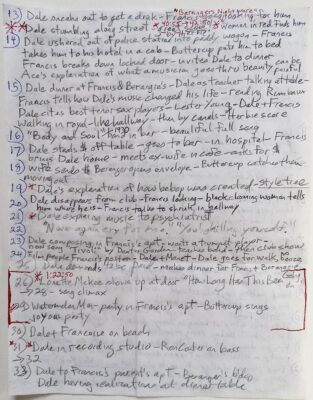
Right after Dale & Francis first meet, then go back to the Blue Note, we’re treated to the song Bud Powell actually wrote for the real Francis — the joyous uptempo Afro-Cuban Una Noche con Francis (A Night with Francis) — with fellow tenor master Wayne Shorter duetting with Dex (the only time they ever shared a stage!), and Bobby Hutcherson joining on vibes. It is deep-cut touches like this by Herbie & Bertrand that put this film on the top shelf.
Besides the 20 or so jazz classics sprinkled throughout this symphony, one of the hottest musical moments is Herbie’s original score when Dale/Dexter goes missing (41 mins in) and Francis is frantically looking for him on the streets of Paris. Since so much of the movie’s music is focused around a horn player, Herbie takes full advantage of the break and writes a thrilling dramatic polyrhythmic drum-forward sequence. With the disc at home, I replay this 2-minute passage over & over a dozen times whenever I’m watching the movie cuz it’s just so rockin’–cool!
Also, right after the Lonette McKee masterpiece I mentioned above, How Long Has This Been Going On?, we’re taken to a musicians party at Francis’s apartment that begins with Herbie’s classic Watermelon Man, and the proverbial microphone is passed around the party as everyone plays for fun for their friends. Attempts at this kind of scene have been staged by many different filmmakers, but this one was clearly created by the musicians themselves. This is a small private family gathering that outsiders don’t get invited to, and it’s a real treat that this film takes us to one.
As Dexter’s character says at one point — “You just don’t go out and pick a style off a tree one day. The tree is inside you growing naturally.”

Dexter, Wayne, Billy, Ron, director Bertrand Tavernier & Herbie
This movie takes us inside the mind & life of jazz musicians like no other. The original Francis was entrusted with the access of a bandmember. He captured Bud & others on film, on tape, and in words, and ultimately shared it all with the world. Thank god an artist of similar sensibilities, Bertrand Tavernier, took that treasure trove and crafted it into this masterpiece of a dramatic film . . . co-creating it with living jazz masters Dexter Gordon and Herbie Hancock and all the other geniuses they wove in.
Both the music and the film worlds are forever richer for this masterpiece having been forged from the smithy of their souls.
.
=========================================
.
.
.
======================================
.
Here’s the full masterpiece of a performance . . .
.
And here’s the all-star Una Noche con Francis with Wayne Shorter & Bobby Hutcherson joining in . . .
.
======================================
.
Here’s a tale of another musical movie . . . set in Europe . . . featuring jazz and Jack Kerouac . . .
.
And here’s where ‘Round Midnight joins 24 other masterpieces on my Greatest Movies of All-time list . . .
.
Or here’s some of Brian’s tips to maximize your experience at the New Orleans Jazz Fest . . .
.
==================================
.
by Brian Hassett
karmacoupon@gmail.com — BrianHassett.com
Or here’s my Facebook page if you wanna join in there —
https://www.facebook.com/Brian.Hassett.Canada
22 responses so far ↓
1 Richard Modiano // Jun 6, 2026 at 11:59 AM
Round Midnight won two César Awards (Best Original Music and Best Sound), the Best Film Award at the Venice Film Festival and the Oscar for Best Music (Original Score) at the 1987 Academy Awards, one of Bertrand Tavernier’s best pictures. Also, Tavernier directed the best adaptation of a Jim Thompson novel, Pop. 1280, released under the title Coup de Torchon (1981.)
2 Jeremy Burwell // Jun 6, 2026 at 1:02 PM
This is a great film and really captures the Jazz ethos. You can’t take your eyes and ears off Dexter Gordon’s character! Plus it features so many other fine musicians; Wayne Shorter, Bobby Hutcherson, Billy HIggins, John McLaughlin, and Ron Carter among others. I’ve watched the DVD several times and saw it on the big screen a few years ago in Greenwich Village. That was special, it was hosted by Dexter’s widow, Maxine and other Jazz luminaries, including the late Michael Cuscuna.
Maxine also wrote a fine biography of Dexter, “Sophisticated Giant” Well worth reading.
3 Brian Hassett // Jun 6, 2026 at 1:45 PM
Oh, wow, Jeremy! Well played! What a great New York jazz night! I just got hipped to Maxine and just started digging into the wealth of interviews with her on YT. And yeah, the all-star bands in the movie (!) . . . and how it’s all played and recorded live on camera (!) . . . and how there’s full songs unlike virtually every other movie about music where they play one-minute versions of everything. A movie about music and musicians . . . and the music comes first.
4 John Cassady // Jun 6, 2026 at 3:21 PM
It’s Brilliant! You Can’t “Beat” It! (Ha ha). Carolyn, Jack, and Neal Loved “All That Jazz!” Musically Yours, Johnny “Tenor Sax” Cassady. PS: In my “Garage Bands,” back in “The Day,” the other Players would ask me to sing “Tenor.” I would reply, “oh, as opposed to “Alto” or “Soprano.” They would say, “No. Ten or Twelve Miles Away!” Or they would ask me to sing “Solo.” “So Low That We Can’t Hear You!” I Get No Respect!
5 Dale Topham // Jun 6, 2026 at 4:11 PM
Amazon say’s it’s going to walk up my driveway tomorrow! It’s the Criterion collection edition. Probably will watch it with Uncle Mike at his place Sunday. Thanks for this one, Brian.
6 Brian Hassett // Jun 6, 2026 at 4:51 PM
Oh, GREAT, Dale! I have the regular original DVD but am picking up the Criterion at a friend’s place in PA next month (along with their In The Heat of The Night and Matewan!)
You love how how so many of the songs are full (or nearly full) songs — unlike so many movies with music where they’re more like a minute long.
Also — from roughly 41 to 43 mins when Dale/Dexter goes missing, Herbie Hancock wrote maybe my favorite piece of music in the film — the instrumental as Francis runs around Paris in a panic looking for him.
And — 1 hour 23 mins in — the beautiful Lonette McKee arrives . . . and does “How Long Has This Been Going On” with Dexter & his band — one of the most beautiful soulful touching performances ever on film.
With my DVD I watch those ^ two passages over & over 5 or 10 times each whenever I’m watching the movie.
7 Marc Zegans // Jun 6, 2026 at 7:17 PM
One of my favorites of all time. Such a rich mood this film casts. Dexter Gordon was brilliant in it. I saw it at a festival before its theatrical release and was blown away.
8 Kelly Humphries // Jun 6, 2026 at 8:06 PM
It’s on my “Bought this, why haven’t I watched it yet?” shelf, I’ll try to get to it sometime here…
9 Brian Hassett // Jun 6, 2026 at 8:46 PM
It’s gonna blow yer F’n mind, Kelly! But the funny thing is — it sparks SO many ideas and worlds I wanna fly off into . . . sometimes it takes me days to get through it because it just spawns so many new worlds to explore!
10 Carl Spiby // Jun 6, 2026 at 9:08 PM
This movie and Bird were a big part of my early love of jazz – this hadn’t long come out and I was about 17. Hooked. All I had was a cheap cassette tape of Charlie Parker recordings, and these two movies. Never looked back. I loved jazz, bebop before I read the Beats. So when I hit Kerouac, HOLY MOTHER OF SHIT the page talked in music, in bop. Floored.
11 Edward Heflin // Jun 6, 2026 at 9:15 PM
I saw it three times the year it was released. Dexter Gordon was magnificent.
12 Chris Shamro // Jun 6, 2026 at 11:04 PM
I was just listening to Dex last weekend tryin to remember the name of this movie!
13 Rick Medland // Jun 7, 2026 at 1:03 AM
Soundtrack is amazing.
14 Flow Jones // Jun 7, 2026 at 11:08 AM
I wasn’t familiar with this movie. Thanks for making me aware!
15 Jeremy Burwell // Jun 7, 2026 at 10:35 PM
Thanks again for this fine review of one of my favorite films. I did want to mention that Dexter Gordon did act on the stage in The Connection, in the late ‘50s-early ‘60s. It was a play about a drug addicted Jazz musician. So he did act in the theater if not on film before Round Midnight.
I believe there is a soundtrack album for the play on Blue Note records. And I think the great alto sax player Jackie McLean was in it at some point as well.
16 Brian Hassett // Jun 7, 2026 at 11:51 PM
Thanks, Jeremy! I did not know about him doing The Connection in L.A. Very cool. He certainly had acting chops!
17 Antonis Greco Imdb // Jun 8, 2026 at 7:53 PM
Great movie. I saw it in Amsterdam.
18 Johnny Walker // Jun 9, 2026 at 6:39 PM
Thank you Brian!
19 Kelly Humphries // Jun 11, 2026 at 7:32 PM
Amazing lineup of musicians in those bands onscreen. The night before watching this I saw a John McLaughlin performance from French TV in 2010. Following that up by seeing him suddenly 25 years younger was a trip in itself.
20 Brian Hassett // Jun 11, 2026 at 9:06 PM
Yeah, Kelly! I had a similar reaction to seeing a young Herbie Hancock from 40 years ago!
21 Dale Topham // Jun 15, 2026 at 7:25 PM
What a treat!
Another great movie from the “King of the Cinema”, Brian Hassett.
I watched with Uncle Mike on our movie Sundays which happen when there is no football. I reread your review before we watched it.
A gem of a movie about Jazz in Paris in the fifties.
You really get the feel that you have been transported back to the fifties and have spent time in the Blue Note café. It seems almost like the concept in “Midnight in Paris”, (another favorite movie of mine), where the hero is transported (magically) back to Paris in the twenties to mingle with ‘the lost generation’.
This movie is all about the music… and it is awesome. All the players are professional jazz musicians, (not actors), and we loved getting the full songs instead of snippets.
As soon as I got home, I hauled Miles Davis, “Sketches of Spain” off my cd shelf for permanent rotation in my car. It was recorded in 1960… just about the time this movie is set. It is pretty much the only Jazz album that made my ‘Top Albums’ list. (at #14) It has probably been at least 25 years since I listened to this album!
If I had not read your review I would have had no idea that the fast talking New Yorker who greets them on arrival is Martin Scorsese! Funny but I just read about Martin in Robbie Robertson’s biography. Both their wives left them while they were working together on ‘The Last Waltz”. They ended up living together.
Great Movie. Great review. Everybody should check it out… for an evening in Paris in The fifties.
22 Brian Hassett // Jun 15, 2026 at 9:30 PM
Oh, fantastic, Dale! So glad you & Uncle Mike got to see it and loved it! Ain’t it a doozie?!
Great allusion to “Midnight In Paris” — hadn’t thought of that, but totally apt.
I didn’t mention it in my review, but there was also an aspect of “Almost Famous” in the innocent getting invited into the world of his musical heroes.
Leave a Comment